Celebrate a special occasion on a historic riverboat
Toasting and dancing on the banks of the Tiber is no longer a dream but a real possibility, thanks to The Boat by Gregory’s, a historic Roman riverboat that transforms into the perfect setting for celebrating a special occasion. If you’re looking for a private event venue in Rome that breaks the mold, this is something no villa or rooftop can offer: a party on the water, in the heart of the city.
The Boat by Gregory’s is not open to the public, but can be booked exclusively for private events of all kinds, becoming an authentic floating lounge and ballroom on Lungotevere Arnaldo da Brescia, just steps from Piazza del Popolo and the city center. The venue hosts a wide range of occasions: birthdays, graduation parties, anniversaries, marriage proposals and wedding receptions, as well as corporate events such as company dinners, brand presentations, networking and incentive events for both Italian and international companies.
A venue steeped in history and culture
The riverboat that today hosts The Boat by Gregory’s is the oldest on the Tiber: the structure dates back to 1890, when it was built as the home of a swimming society, the Rari Nantes. In 1920 it was inaugurated as the headquarters of the Dopolavoro Ferroviario, the railway workers’ recreational club, a role it still holds today: not just a mooring point on the river, but a true floating gym dedicated to swimming, diving, rowing and social gatherings. In those years, the bond between Romans and the Tiber was far closer and more part of everyday life than it is today: the riverbanks were a place to meet and unwind, not just a backdrop to be admired from the bridges and photographed for Instagram.
Over the decades, the structure has lived several lives without ever losing its connection to the water where it was born. The latest is The Boat by Gregory’s, born about ten years ago, which has added a new vocation for hospitality and private events to its sporting and social dimension. The riverboat also remains tied to cultural activities, first and foremost jazz, with an occasional program of concerts that every now and then brings the riverside evenings to life.
This musical connection stems from its link to the famous Gregory’s Jazz Club on Via Gregoriana, one of the historic venues of the Roman music scene, which gives the location a distinctive sound identity: piano bar, DJ sets, saxophone and live performances can all be woven into the evening’s program, always tailored to the tastes and needs of the event, without ever turning the space into a themed venue.
The spaces: indoor rooms and a panoramic terrace over the Tiber
The boat is divided into distinct spaces, each with its own function and atmosphere, designed to suit very different occasions. The Jazz Room is the most intimate and welcoming soul of the venue, perfect for dinners, cocktails, presentations or small private events where a cozier indoor atmosphere is preferred. The Marina Room, on the other hand, lends itself to more convivial moments such as buffets, aperitivos and corporate events, while maintaining a constant visual dialogue with the river even under cover.
The true standout feature, however, is the panoramic Terrace, overlooking the Tiber directly, offering an unusual perspective on the city and the adjacent bridge. It’s the ideal spot for sunset aperitivos, toasts, cake cuttings or small moments of entertainment with a view of the water. The combination of indoor and outdoor spaces makes it possible to plan events all year round, always guaranteeing a sheltered alternative in case of bad weather or cooler temperatures, without sacrificing the charm of the location.
Private parties, but corporate events too
For the business world, The Boat by Gregory’s offers an unconventional alternative to the usual meeting rooms: a central, easily accessible position with plenty of parking nearby, combined with a secluded and distinctive atmosphere. Over the course of a single evening, different moments can follow one another, from the welcome drink to dinner and on to the DJ set, making it the ideal format for company dinners, product launches and networking events.
On the wedding front, it stands as an alternative to villas, rooftops and traditional reception halls, ideal for intimate receptions, welcome dinners or post-ceremony parties, where the Tiber becomes an integral part of the story rather than a simple backdrop. The offer is further enhanced by the possibility of adding private cruises and mini tours on the river, turning the venue not just into a place to host events, but into a true starting point for discovering Rome from an unusual perspective: that of its river history.
One final detail worth mentioning: the boat remains moored at all times, so there’s no risk of finding yourself stuck on the river with nosy colleagues or relatives. You can always step off and head back into the city whenever you like.
August in Rome is hotter than you could ever imagine, and it’s the month of Ferragosto, the national holiday on August 15th introduced by Emperor Augustus in 18 BC, when Italians flock to the seaside. Some shops and bars in residential areas close as Romans take their well-deserved holidays, and for a couple of weeks the city belongs to visitors.
That’s exactly why August has its own charm. The streets are quieter, the lines for major attractions shrink, restaurants in the center stay open, and the city fills up with open-air festivals, concerts and night openings you won’t find any other time of the year. If you don’t mind the heat and plan your days around it, August can be one of the most enjoyable months to experience Rome.
Here’s everything you need to know: the weather, what to wear, what’s open on Ferragosto, and the best things to do. And to avoid long queues under the sun, remember to book your tickets and tours in advance.
The weather in Rome in August
Summer in Rome is hot and humid, and August is its peak. During the day, average temperatures range from 30°C to 38°C (86°F to 100°F), cooling down to around 24-26°C in the evening. Rain is rare, the sun is relentless.
The trick is to plan your days like the Romans do: visit outdoor sites like the Colosseum, Roman Forum and ancient ruins early in the morning, keep air-conditioned museums and churches for the afternoon, and take a proper break after lunch. Evenings are when the city comes alive, so save your energy for aperitivo hour onwards.
What to wear in Rome in August
Pack light, but pack smart:
Comfortable shoes are non-negotiable: Rome is paved with cobblestones. Breathable trainers or sandals with thick soles work best.
Shorts are fine for walking around, but you won’t be allowed into religious sites with knees uncovered.
T-shirts are ideal: light, and they cover your shoulders, so you can enter any church or the Vatican.
A scarf or light shawl is the smartest item in your bag: it lets you cover shoulders on the spot when entering churches, without wearing sleeves all day.
Sunglasses, sunscreen and a hat: the sun is on full blast, and getting burnt on day one is not the souvenir you want.
Long pants or a dress for the evening: Romans dress smart-casual for dinner, and some clubs require a shirt, dark pants and proper shoes for men.
One more local tip: fresh drinking water is free and everywhere in Rome. The public fountains, known as ‘nasoni‘ for resembling big noses, are scattered across the city. Bring an empty bottle and refill as you go.
Events in Rome in August 2026
August in Rome is anything but empty. The Estate Romana program fills the city with open-air concerts, film screenings and festivals: outdoor cinema under the stars, music and nightlife on the river banks at Lungo il Tevere, opera and ballet at the Baths of Caracalla, jazz at Village Celimontana, and night tours of the Colosseum by moonlight. And on the night of August 10th, the feast of San Lorenzo, Romans head to Gianicolo hill, the Pincio terrace or the Appia Antica to watch the shooting stars.
Ferragosto is the heart of the Italian summer: families gather for long lunches, picnics and days at the beach, and many businesses close for the day or the surrounding week.
The good news for visitors: most of Rome’s museums and archaeological sites remain open on August 15th, including the Colosseum, the Roman Forum and the Borghese Gallery. The main exceptions are the Vatican Museums, which close for the holiday, along with many family-run restaurants and shops. Book your Ferragosto dinner table in advance, and double-check opening hours for anything on your list that day.
If the heat gets too much, do as the Romans do and head to the coast. Ostia is the closest, and pairs the seaside with a remarkable archaeological site: the Ostia Antica Archaeological Park. About an hour away by train you’ll find Santa Marinella and Santa Severa, with its castle right on the sea, while Anzio, Fregene, Sabaudia and Sperlonga offer some of the region’s best beaches and seafood. Check out our guides to the best beaches near Rome and the best restaurants on the Roman coast.
If leaving the city is not an option, Rome has plenty of swimming pools open in August: from the athletic Piscina Belle Arti near Villa Borghese to the Olympic-sized Piscina delle Rose in EUR, up to luxury hotel pools where you can spend a full day between loungers and cocktails.
The August heat is the perfect excuse to make a real holiday of it. Relax in the shade of Villa Borghese or Villa Pamphilj, lose yourself in the Caffarella Park, or explore the Park of the Aqueducts at sunset. Discover all the best parks and gardens in Rome: the city rewards those who move slowly.
Restaurants open in Rome in August
Eating out is one of Rome’s greatest pleasures, but August requires a little planning: some restaurants close for a week or two as owners take their holidays, especially around Ferragosto. Most places in the center stay open throughout the month.
The idea sounds dreamy: a Vespa ride at sunset, gelato in your hand, a kiss in front of the Colosseum… simply living la dolce vita. But, unfortunately, the dream melts just as quickly as your gelato, under the Roman sun.
Summer in Rome means beauty, yes, but also fighting heat, humidity and sticky air. But don’t worry: we’re giving you our best tips to make your Roman dream still magical.
What’s the weather like in summer?
Let’s start with the obvious: Rome gets very hot in summer, and it’s getting hotter every year. 2025 was the city’s third-hottest year since 1991, with more than 40 days above 35°C (95°F) and over 110 “tropical nights”, when the temperature never drops below 20°C (68°F). From late June to early September, expect daytime temperatures regularly between 32°C and 38°C (90-100°F), with humidity making it feel even hotter.
When planning your days, build your schedule around the heat: avoid outdoor sightseeing during the hottest hours (roughly 12:00 PM to 5:00 PM), and explore in the early morning or after sunset, when the city is at its most beautiful anyway. Use the afternoon to cool off in a museum, enjoy a long lunch indoors, or take a well-deserved gelato break in the shade. Keep in mind that air conditioning is still not guaranteed everywhere, especially in older buildings, apartments and public transportation.
What to pack?
First of all: don’t overpack. Keep it simple and minimal: with temperatures this high, you won’t need layers, just light, loose-fitting clothes. Here’s what to bring to stay comfortable and avoid unnecessary sweating and fatigue:
Light and breathable clothing (cotton or linen is best)
Comfortable walking shoes or sandals, Rome’s cobblestones are unforgiving
A hat, sunglasses, and sunscreen
A light scarf or shawl to cover shoulders when visiting churches (knees and shoulders must be covered in St. Peter’s and most basilicas)
Rome is one of the most visited cities in the world, and summer is peak tourist season. Major attractions like the Colosseum, Vatican Museums, and the Pantheon can sell out days (or even weeks) in advance. Not sure whether a simple ticket or a guided tour is the better choice? Here’s our full breakdown of Colosseum tickets vs guided tours to help you decide.
Heads up for Pantheon visitors: as of July 1, 2026, the entry ticket has gone up from €5 to €7, while the reduced €2 ticket for visitors aged 18-25 and all existing free-entry categories remain unchanged. Read all the details in our article on the Pantheon ticket price increase.
Pro tip: if you’re here in June/July or September, don’t wait until the last minute to book museum tickets, tours, or even popular restaurants. Planning ahead will save you time, money, and a lot of stress.
The Roman Summer Experience changes in August: many locals leave the city to escape the heat, making the streets quieter, but also leaving some shops and restaurants closed. We always recommend checking opening hours in advance to avoid surprises.
Museums, Churches and Catacombs: Culture in the Coolest Places
Rome hides some of its greatest treasures behind thick stone walls, and often below ground. Churches like San Clemente, with its fascinating underground layers, or Santa Maria in Trastevere, a peaceful gem with golden mosaics, offer the perfect mix of beauty, history… and blessed shade. Prefer to stay indoors? Choose from Rome’s countless museums, where you can soak up centuries of art and culture while staying cool.
Need a true cool-down? Head underground into one of the catacombs of Rome, such as San Sebastiano or San Callisto: ancient, mysterious, and a solid 16°C all year round. A cultural escape and heat relief in one smart move.
And once the sun sets, ancient Rome has one more trick up its sleeve: on Tuesday and Thursday evenings you can explore the Colosseum by night, wandering the arena and underground chambers in the cool evening air, without the daytime crowds.
Beyond the Heat: Cool Escapes Outside the City
After you’ve done it all – museums, churches, early morning walks at 5am – you might just want to escape for a day and stop thinking about heat, sweat, and crowded streets.
Our top suggestion? Head to the beach, a pool, or even a lake. These are the perfect places to cool off, unwind, and remember what it feels like not to be melting.
Rome isn’t a beach city, but the coast is just a short train or car ride away. You’ll find sandy shores, beach clubs with loungers and umbrellas, and charming seafood spots by the water.
Take a day trip to Ponza Island, a Mediterranean dream that rivals Capri, but without the crowds. Ponza’s dramatic white cliffs, crystal waters, ancient grottoes, and pastel-hued port are best experienced by boat. Join a full-day excursion including transportation from Rome, a 5-hour boat tour with swim stops, and lunch on board.
And if you’re not in the mood to hop on a train, drive around, or get wet at all, we’ve got you covered too. Rome’s parks can be a lifesaver in the summer, especially early in the morning or late in the afternoon, when the air is cooler and the vibe is calm.
Dining Al Fresco: from Secret Gardens in Rome to Sunset Dinners by the Sea
When the Roman heat hits hard, sometimes the best way to cool off is… with dinner. Dining al fresco isn’t just a charming Italian tradition, it’s also a much-needed escape from stuffy indoor spaces and overheated streets.
In Rome, you’ll find garden restaurants tucked away in courtyards, shaded terraces hidden behind historic facades, and leafy spots where you can enjoy a cool breeze along with a plate of pasta. It’s the perfect way to relax after a long, hot day of sightseeing, no AC needed.
And if you’re heading to the coast, things get even better. Seaside dining means enjoying the sea breeze, fresh seafood, and a view that makes everything taste better. Whether you choose a casual beachfront trattoria or a fancier place with sunset views, the Roman coastline offers the ultimate cool-down dinner experience.
Summer Nights in Rome: Rooftops, Summer Bars and Outdoor cinema
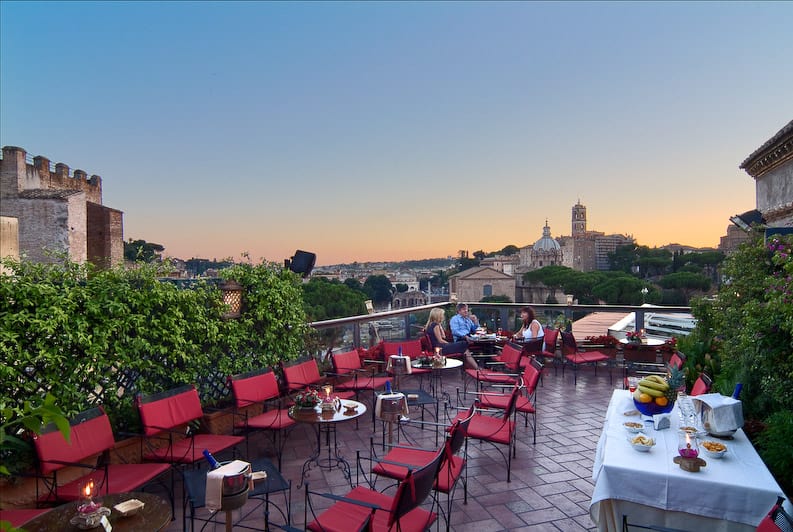
When the sun starts to go down, head to one of Rome’s stunning rooftop bars. Whether you’re looking for a romantic sunset over the city or a cool place to sip a cocktail with friends, rooftops are where Roman summer nights truly come alive.
Some of the best rooftop spots can get busy, so remember to always book in advance.
After your aperitivo, instead of wandering endlessly around the city, you can sit back and enjoy an outdoor movie screening in a piazza, a park, or even in Villa Borghese. Most of these screenings are free and don’t require a reservation.
Summer brings a desire for fun, meeting new people, and staying out late. So what could be better than heading to one of Rome’s many open-air venues? Perfect for a sunset drink or dancing under the stars late into the night.
Remember: visiting Rome in summer should not be taken as a marathon. The best way to enjoy the city even with impossible temperatures is to slow down and accept that you won’t be physically capable of seeing everything you included on your to do list.
Sometimes, it’s better to just relax a bit and have an aperitivo instead of trying to squeeze all the piazzas and attractions in one day while surviving the heat.
So, in order to make the most without sacrificing both your physical and mental health, here are some don’ts you might want to consider:
Don’t skip reservations: Whether it’s restaurants, attractions, or workshops, Rome in summer is not the time to wing it.
Don’t underestimate the heat: Plan indoor activities during midday, and save walking for the morning or late afternoon.
Don’t expect A/C everywhere: Many cafés, shops, and buses don’t have air conditioning. Dress smart and stay hydrated.
Don’t try to do everything in one day: The heat will slow you down. Prioritize and enjoy at a slower pace, la vita lenta style!
Cool Cultural Experiences (Away from the Midday Sun)
Looking for something cultural but refreshing? Here are some indoor-friendly activities that combine creativity, food, and fun:
Pasta & Gelato Class: Make fresh pasta and creamy gelato from scratch with expert chefs in a cozy Roman kitchen.
Pottery Workshop: Shape and decorate your own clay bowl in a Monteverde studio, guided by local artisans.
Mosaic Workshop in Trastevere: Learn mosaic-making techniques and craft your own piece to take home, all in a charming studio.
Gelato Lab: Perfect for adults and kids alike: discover the secrets of Roman gelato and fruity sorbets.
Vespa Street Art Tour: Hop on the back of a Vespa to explore Rome’s colorful murals in spots like Tormarancia and Garbatella.
Golf Cart Tour: Discover Ancient Rome in comfort, with a private guide and zero walking, ideal for hot days.
Sunrise Tour of Rome. Explore Rome in all its splendour while the city is still asleep, and jump-start your day with a 3-hour private sunrise tour led by a driver-guide.
These experiences are air-conditioned, small-group, and a great way to dive into Italian culture away from the crowds.
We know summer in Rome can be very intense, but let’s be honest: we also know how to make it unforgettable. After reading this article, all that’s left to do is book your flight and pack your bags, because you’ll most certainly be able to enjoy la dolce vita (yes, even at 35 degrees!). Buone Vacanze Romane!
Night tours at the Colosseum are back – every Tuesday and Thursday from 8 to 11 PM
Starting Tuesday, July 14, the “A Night at the Colosseum” initiative returns — a guided tour that offers the rare opportunity to visit the Flavian Amphitheater after dark, including areas usually closed to the public.
The 60-minute tour once again includes the first level of the monument, the arena floor, and the underground tunnels — a truly unmissable chance to uncover the secrets of Rome’s most iconic landmark.
Special evening openings are scheduled every Tuesday and Thursday from 8:00 PM to 11:00 PM, with last entry at 9:50 PM. Tours are conducted in small groups of up to 25 people per slot.
The visit unfolds like a story, told from the perspective of the spectators who once filled the Colosseum, as well as that of the protagonists of the spectacles held throughout the day, from wild animal hunts (known as venationes) to the munera, the gladiator combats – fighters who were admired and cheered like today’s football stars.
The night tour begins at the northern entrance arch, once the main access point for emperors. From the arena floor, visitors enjoy a striking view of the cavea while learning about the grand spectacles once offered to the Roman public.
The tour then leads into the underground area, featuring the permanent exhibition “Spectacles in the Colosseum Arena: The Protagonists”, which highlights the lives of gladiators and wild animals involved in the shows, with dramatic elements like:
A holographic projection of gladiators emerging from the darkness
A 2nd-century AD mosaic depicting a hunting scene
Ancient graffiti, oil lamps, and lift mechanisms used to bring fighters and beasts to the arena
Full-scale replicas of gladiator armor, from the retiarius to the murmillo
Are you ready to enjoy an unforgettable show? All you have to do is book your visit on the official website of the Colosseum Archaeological Park, just remember that tickets are available ONLY on the official website, starting 7 days before the scheduled visit date.
From July 14, 2026 Flavian Amphitheater – Piazza del Colosseo, 1
Guided tour times (in Italian, Spanish and English): From 8:00 PM to 11:00 PM
Tickets:
€50.00 full price (includes Full Experience ticket €24.00 + guided tour €26.00)
The sweltering heat isn’t the only thing rising in Rome this summer. As of July 2026, the standard Pantheon entry ticket has officially gone up from €5.00 to €7.00. It’s not going to break the bank: an extra €2.00 to preserve 2,000 years of history is a small price to pay to stand inside the ancient world’s greatest architectural marvel. Even with the price hike, the Pantheon remains the cheapest major monument to visit in the entire city.
How Much Does It Cost to Visit the Pantheon in 2026?
The standard Pantheon ticket price is now €7.00. Reduced tickets and free entry categories (under 18s, Rome residents, worshippers attending mass) remain in place. For full visitor information, opening hours and history, read our complete guide to visiting the Pantheon.
When Is the Pantheon Free to Visit?
If you happen to be strolling past the coffee-scented streets of Piazza della Rotonda on a Sunday, you may be in luck: like the Colosseum and the Roman Forum, the Pantheon is completely free on the first Sunday of every month. Keep in mind you’ll have to queue for a physical ticket, as online booking isn’t available on free days.
On any other day, our advice is to book your Pantheon tickets online and in advance, when the piazza gets crowded, nobody wants to melt in line under the midday sun.
Absolutely. The dome of the Pantheon is still the world’s largest unreinforced concrete dome, rebuilt by Emperor Hadrian nearly two millennia ago. Born as a pagan temple dedicated to all the Roman gods, in 609 AD it was gifted to the Pope and consecrated as a Christian church, Santa Maria ad Martyres. The hole at the top of the dome, the famous oculus, is the building’s only source of light. And for those wondering what happens when the heavens pour: yes, it rains inside! Rain, hail, storms or religious upheaval, the most fascinating thing about the Pantheon is its survival story.
Want to Get More Out of Your Visit?
A guided visit brings the Pantheon’s 2,000 years of history to life. Here are two experiences we recommend:
Rome’s hidden treasures: a guide to unforgettable adventures for every age and interest.
Rome is one of those cities that never runs out of surprises. Whether you’re planning your first visit or your tenth, there are always new fun things to do in Rome that go beyond the obvious, and that’s exactly what this guide is about.
From offbeat food discoveries and secret viewpoints to Vespa rides through cobblestone streets and rooftop cocktails at sunset, we’ve put together a selection of experiences that capture what makes Rome so endlessly exciting. Perfect for couples, families, and solo travellers alike. Whatever your pace, the Eternal City has something for you.
Discover Rome’s Unusual Foods
Carciofi alla Giudia
Alright, buckle up for a culinary rollercoaster ’cause we’re about to dive into Rome’s most unusual food tour! First stop, get your taste buds ready for some ‘Jewish artichokes‘ in the Jewish Ghetto – crispy, golden, and addictive. Next, scoot over to Testaccio, a regular stomping ground for foodies, and snag a bite of the quinto quarto (offal) if you dare.
Feeling adventurous? Try the pajata (intestines of an unweaned calf) – it’s a Roman delicacy that’ll have your palate doing somersaults. Don’t miss out on the trapizzino, a pizza-pocket filled with drool-worthy classics like oxtail stew.
Wrap it up with a gelato but go for quirky flavors like black sesame or blue cheese. Remember, when in Rome, eat as the Romans do – maybe with a side of fearless fun!
Rome Food Market Tour
Explore Rome’s foodie Trionfale district near the Vatican: start with a fresh cannolo and cappuccino, enjoy iconic slices at Pizzarium, then sample cheeses, cured meats, truffles, aged balsamic, and olive oils. Finish at the lively Trionfale Market, rich in colors, sounds, and local characters.
Looking for something spooky? Try a visit to the Capuchin Crypt on Via Veneto – a macabre masterpiece lined with monk bones. It is several small chapels located under the church of Santa Maria della Concezione that’s walls are lined with the remains of about 3,700 skulls. The arrangement of the skulls and other bones are equally captivating and creepy. It’s not your average art gallery, but it’s a definite must-see for the morbidly curious.
Seeking some Roman art that is different from the standard classical era artworks in the museums? Hit the Ostiense District and get your fill of incredible street art. This place is a canvas for renowned artists who’ve turned these streets into a feast for the eyes. Snap some pics of these vibrant and edgy murals!
Stroll around, grab an espresso, orhop on vespa tourand watch as the walls tell you tales of modern-day Rome. Ostiense is where ancient history shakes hands with urban cool, and let me tell you, they get along just fine. Dive into this colorful world, and who knows, you might just bump into an artist creating their next masterpiece. Fun, artsy, and a little rebellious – Ostiense’s street art scene is an undefined must-see for your Roman holiday.
Ready to channel your inner chef in the Eternal City? Sign up for a cooking class with a local Roman chef! You’ll craft perfect pasta, and prepare a classic Italian tiramisu. It’s hands-on, it’s delicious, and hey, it’s a skill you can flaunt at your next dinner party.
Do not miss your chance to spice up your trip and your culinary game. Plus, you’ll get to eat your homework—talk about a tasty lesson! Whether you’re a young adult looking for an epic foodie experience or hunting for a family-friendly activity that’ll keep the kids entertained, this is a must-do.
Get ready to don that apron and cook up a storm, Roman style!
Fettuccine, Ravioli and Tiramisù Cooking Class
Discover the secrets of traditional Italian cuisine during this hands-on cooking class in Rome.
With the guidance of an English-speaking chef, you will learn how to prepare fresh fettuccine from scratch, ricotta-filled ravioli inspired by a traditional grandmother’s recipe, and one of Italy’s most iconic desserts: tiramisù.
Discover the Secret Keyhole View of St. Peter’s Basilica
Oh, you’re in for a treat with this one! Make your way to the Aventine Hill, where a nondescript door hides a mind-blowing peek at St. Peter’s Basilica. This secret keyhole view is tucked inside the Priory of the Knights of Malta, and it’s not just a quirky hole in the wall – it frames the basilica perfectly through a lush garden avenue.
It’s a magical experience, and the best part? It’s free! So go ahead, play a little game of “I spy” with the grand St. Peter’s Basilica. It’s a view you are guaranteed to remember for a lifetime!
Monks and Knights *slow* tour on Aventine hill
Discover Aventine Hill at a leisurely pace: medieval monasteries, historic basilicas, and the Knights’ sanctuary. Stroll through gardens with sweeping views—including a famed hidden vantage of Rome—hear legends of monks and knights, and finish with gelato overlooking the Circus Maximus. A compact, culture-rich walk.
Gelato is a must-taste while you are in Rome! So, if you were looking for an excuse to go for a sweet treat, here it is! Roman gelato shops feature a vast array of flavors, so be sure to branch out and try something new while you are here.
If you would like to learn the secret to tasty gelato you can try this hands-on gelato making class. It is perfect for adults and kids to experience the process of gelato making in the laboratory of an authentic Roman gelateria.
Learn To Make Gelato in Rome
Learn to make gelato with our hands-on gelato-making class in Rome. It’s fun for adults and it’s fun for kids too!
Cruising around Rome on a Vespa is the epitome of cool – it’s like starring in your own Italian movie! Imagine zipping through the bustling streets, wind in your hair, as you dart from one iconic landmark to another.
It’s not just a ride; it’s your ticket to feeling like a local, and truly experiencing the vibrant Roman atmosphere. Plus, it’s a nifty way to dodge the slower pace of tourist traffic. For young adults seeking a dash of adventure, it’s one of the most exhilarating fun things to do in Rome.
There are tons of different options for touring around Rome. You can enjoy a vespa sidecar tour, a vintage vespa tour, or a vintage car tour of Rome. Choose which mode of transportation best fits your style and have fun! Just remember to wear your helmet and live the dolce vita responsibly.
Visit a Rooftop
Rooftops in Rome are like pizza with the perfect crust – simply a must! Imagine sipping on a Spritz while catching a golden sunset with the silhouette of St. Peter’s Basilica in the skyline. It’s not just a drink; it’s a scene straight out of a chic Italian film.
Rooftop bars are a playground for young adults, offering not just killer views but also a vibe that’s buzzing even more than a Vespa on cobblestones. And when the stars come out, these high-rise hotspots turn into a nocturnal festa – think live DJs, swanky cocktails, and a crowd that’s dressed to impress. Ascend to one of Rome’s sky-high oases for a night or twilight to remember!
Looking to spend a balmy evening doing aperitivo or dinner with a panoramic view over the city? Rome is one of Europe’s best cities for rooftop bars and panoramic terraces, perfect for a sunset aperitivo or a romantic dinner under the stars, but finding complete and up-to-date information online isn’t easy.
That’s why we have selected, visited and verified 35 rooftop bars in Rome: from the most iconic panoramic terraces in the historic centre to the best bars with views of St. Peter’s Basilica, the Colosseum and the Spanish Steps, right up to the newest openings of summer 2026. A real-time updated guide, with addresses, opening hours and direct contacts, designed for those who don’t want to waste time searching through scattered, often outdated information.
Here are our favourite rooftop bars with a view in Rome, from sunset aperitivo to drinks under the stars.
Les Etoiles offers a truly spectacular 360° panoramic view of Rome, stretching across terracotta rooftops and the city’s most iconic monuments. The view takes in the best view we’ve ever seen of the facade and dome of St. Peter’s Basilica.
Spread across the top floors of the Atlante Star Hotel, Les Etoiles is composed of three distinct spaces: a refined indoor restaurant, a charming roof garden, and a panoramic rooftop bar. At aperitivo time, a fixed-price formula is available for €45, which includes a drink (cocktail or glass of wine) accompanied by a selection of finger foods.
Cielo Bar @ Hotel de la Ville
Via Sistina, 69 (Centro Storico) Bar: 12pm – 12am Restaurant:12.30pm – 2.30pm; 7.30pm – 10.30pm
Cielo is a glamorous rooftop bar at the very top of the Spanish Steps. Come to enjoy an aperitivo and bar menu, with live music from 7pm to 10pm. The rooftop is lined with red and white striped umbrellas so you might think you were in Positano if it wasn’t for the spectacular city views.
Gigi Rigolatto @ Hotel Orient Express La Minerva
Piazza della Minerva, 69 (Pantheon) Restaurant: 12pm – 2.30pm, 5pm – 7pm, 7pm – 10.30pm Bellini Bar: 12pm – 11.30pm
Gigi Rigolatto has recently made his debut in Rome, bringing his “La Vita alla Grande” philosophy to the exclusive rooftop of Orient Express La Minerva. One of the most stunning rooftops in the city, it offers an unparalleled view of the Pantheon and the timeless beauty of Rome. The design blends retro glamour with modern elegance, perfectly capturing the spirit of La Dolce Vita.
Masa Rooftop
Via di S.Maria Maggiore, 143 (Monti) Opening Times: 6pm – 1am
Hotel Major’s rooftop restaurant reimagines the classic Italian aperitivo experience with a Middle Eastern infusion. Masa embraces conviviality as its principle: customers embark on a culinary adventure, savoring the chef’s selection of small bites. If you’re seeking a romantic spot to dazzle your date or craving an evening of refined Oriental finger food, Masa awaits you for a memorable night!
Adèle Mixology Lounge
Via di Porta Pinciana, 14 (Veneto) Opening Times: daily from 5pm to 1am; Sunday brunch from 12pm to 3pm
Rome may feel immense, but from Adèle Mixology Lounge on the 8th floor of Hotel Splendide Royal, the city opens up in a sweeping panorama. From Villa Borghese’s greenery to Rome’s domes and the Vittoriano, the skyline feels close enough to trace with your eyes.
Set on Pincio Hill, just steps from Villa Medici and Piazza di Spagna, Adèle balances grandeur with intimacy: warm lighting, thoughtful design, and a refined atmosphere that never feels crowded or dispersive. A retractable window system makes the space enjoyable year-round, with both indoor and outdoor seating depending on the season and your mood.
Come for a Sunday buffet brunch (12:00–15:00), settle in for afternoon tea, or stop by for an aperitivo and after-dinner drinks. As daylight fades and the city lights come on, every moment here turns into a rooftop experience worth lingering over.
Singer Palace Hotel
Via Alessandro Specchi, 10 (centro storico) Jim’s Bar: 12pm – 12am Le TerrazzeRestaurant: Lunch 12.30pm – 2.45pm; Dinner 7pm – 10.45pm
The Singer rooftop is an oasis with an unbelievable view, allowing its guests to enjoy a bird’s eye view of the Roman rooftops and Via del Corso just a stone’s throw away from the Trevi Fountain. Whether you choose to visit the rooftop for lunch, cocktail hour, dinner, or drinks, Singer staff will pamper you all the way through.
Discover our selection of the best Rome’s Tours & Local Experiences
ThRoof is an elegant rooftop terrace above boutique hotel Triviho, between Barberini and Piazza della Repubblica, offering 360° views over Rome as far as St. Peter’s and the Vittoriano. Open year-round with both outdoor space and a heated indoor area, it’s ideal for lunch or aperitivo with simple, well-crafted dishes (tartare, salads, pinsa, couscous) and classic or signature cocktails. Flexible corners of the terrace can be reserved for private events, while themed evenings with food, music and live entertainment create a contemporary, convivial atmosphere.
Ruby Giulia Hotel Rooftop
Via Agostino Depretis, 45 (Monti/Teatro dell’Opera) Bar: 24/7 Rooftop: 6pm – 11pm
Ruby Giulia Hotel brings to Rome a retro rooftop inspired by the 1970s and spy-story atmospheres. From the seventh-floor panoramic terrace, guests can watch the sunset over the rooftops of the historic center while enjoying classic and creative Spritzes, small plates and music. Just steps from Via Nazionale and the Monti district, it is a new central destination for an aperitivo with a view in Rome.
Paparazzo Bar & Rooftop @ Le Meridien Visconti Rome
Via Federico Cesi, 37 (Prati) Opening times: 6pm-1am
Paparazzo Bar & Rooftop at Le Meridien Visconti Rome, takes us back to 1960s Rome, and at the same time, hurls us into the future. The venue, a lounge nestled under the Roman sky, lulls us into a dolce vita, where drinking a cocktail becomes an irresistible social practice, where chatter, laughter and relaxation go hand in hand and give a concrete meaning to the concept of “happy hour”, making it the most anticipated moment of the day.
The Roof @ The Rome EDITION
Salita di San Nicola da Tolentino, 14 (Veneto) Opening times: 11am – 12am
The Roof at The Rome EDITION is one of the city’s most exclusive terraces, suspended above the rooftops of Rome with views of iconic landmarks such as the Pantheon, the Janiculum Hill and Sant’Andrea della Valle. The elegant, light-filled space unfolds around a travertine pool, with a bar and restaurant area.
The culinary offer takes guests from lunch to evening, with Mediterranean dishes, freshly prepared cuisine, grilled specialties, signature cocktails and an atmosphere that brings a touch of the Riviera to the heart of Rome. Ideal for a panoramic aperitif, a sunset dinner or a refined break above the city.
La Griffe Hotel – Rooftop Bar & Restaurant
Via Nazionale, 13 (Repubblica) Bar: 5pm – 11.30pm Restaurant: 7pm – 12am
In the heart of Rome, suspended between the sky and the rooftops of the Eternal City, Rooftop La Griffe offers an experience that goes far beyond a simple panoramic view. Located on the ninth floor of Hotel La Griffe, it is an exclusive rooftop restaurant and cocktail bar where spectacular sunsets, refined cuisine, and signature cocktails come together in a truly unique atmosphere. The perfect setting for a sunset aperitivo, a romantic dinner, or a special event, it offers breathtaking views that make every moment unforgettable.
Tiziano Terrace Rooftop & Cocktail Bar @ Monti Palace Hotel
Located in the Monti neighbourhood, and up on the 5th floor of the Monti Palace Hotel, this terrace boasts tall windows, a cosy outside area, an impressive bar, and a lovely seating area where customers can enjoy their meals in the sun. It’s the perfect place for the summer (and winter) months!
Via dell’Umiltà, 36 (Trevi) Opening Times: 5pm to 1am
Terrazza Flores, part of the renowned family of Argentine restaurants El Porteño, is located on the stunning panoramic terrace of Hotel Umiltà36, in the vibrant heart of Rome. Considered one of the most captivating rooftops in the city, it offers a breathtaking view of Rome’s rooftops and the Vittoriano—a postcard-perfect panorama.
Spacious and elegant, this rooftop features diverse and welcoming environments, complemented by impeccable service and meticulous attention to detail. The drink list is extraordinary, featuring original cocktails inspired by South American flavors and creative reinterpretations of classic recipes.
The food menu, specifically designed for aperitivo, features must-try dishes like the Wagyu Trio and the Asado Tacos Tasting, perfect to enhance your experience in this exclusive location.
Notos Rooftop @ Six Sense Rome
Piazza di San Marcello (Via del Corso) Opening Times: 6pm to midnight
Notos is the rooftop bar and restaurant of the beautiful Six Senses Hotel Rome. The terrace is a ‘secret garden’, rich with plants, terracotta ceramics, and comfortable loungers. The atmosphere is relaxing and the unparalleled view extends beyond the church of San Marcello al Corso and the bell tower of Montecitorio to other famous monuments and Roman terraces.
Mùn – Rooftop Cocktail Bar @ DoubleTree by Hilton Rome Monti
When daylight falls, Mùn – Rooftop Cocktail Bar is ready to welcome aperitifs, parties and events with its panoramic view over the rooftops of the city and the Basilica of Santa Maria Maggiore, one step closer to the moon. An elegant setting with warm, natural tones is enhanced by the chef’s refined culinary creations, perfectly paired with signature cocktails crafted by expert mixologists.
The Terrazza is Bulgari Hotel Roma’s breathtaking rooftop terrace, offering panoramic views of Rome, stretching from Villa Medici and Trinità dei Monti to the Tiber and the Janiculum Hill. As the day goes on, the ambiance transforms: it’s a place to bask in the sun during the day, enjoy a sophisticated aperitif at sunset, or revel in the enchanting starry sky at night. An intimate and exclusive retreat, it offers the same menu as the Bulgari Bar.
47 Circus Roof Garden @ Fortyseven Hotel
Via Luigi Petroselli, 47 (Circo Massimo) Opening Times: 12pm – 12.30am
From the Jewish Quarter to Circo Massimo, 47 Circus Roof Garden offers sensational views of Rome. Enjoy an aperitivo or dinner, take in the unparalleled views of Forum Boario and Piazza della Bocca della Verità, and watch the city illuminate during the evening.
The Organics Sky Garden @ Aleph Rome Hotel
Via di San Basilio, 15 (Via Veneto) Opening Times: 10am-12am
Head to the 6th floor of the Aleph Hotel near the Trevi Fountain for scenic views over the city. Alongside its restaurant, lounge bar and pool, the rooftop has relaunched as the new Organics Sky Garden, with a food menu inspired by Rome’s hills, signature cocktails dedicated to the city’s rioni, and a fresh entertainment format: Liquid Sessions every Wednesday and Sunset Panorama every Friday from 6.30 pm. Enjoy a beautiful Roman sunset or stay for an evening filled with music, food and drinks, and good company.
The Social Hub Rooftop
Viale dello Scalo S. Lorenzo, 10 (San Lorenzo) Opening Hours: 6pm – 11pm
Discover the rooftop bar at The Social Hub Rome. Located on the 7th floor, this panoramic terrace with pool is open daily to hotel guests and members from 9am to 6pm. After 6pm, the space opens to the public for sunset aperitivos and late-night drinks.
With an unexpected and edgy view over Rome’s Termini Station, the rooftop offers a unique perspective of the city, surrounded by cozy loungers, oversized cushions, and bar-facing seating.
Enjoy a bespoke cocktail experience curated by Bar Manager, Damiano Di Benedetto, featuring a rooftop-exclusive mixology menu inspired by the soul of Rome.
Seu Pizza con Vista @ W Hotel Roma
Via Liguria, 26-36 (Veneto) Opening times: 6.30pm – 12am
Enjoy the view from Seu Pizza con Vista, perched on the rooftop of the W Hotel Rome. Surrounded by lemon trees and accompanied by a live DJ set, you can sip a cocktail while tasting fresh seafood and the signature pizza by Pierdaniele Seu — an award-winning pizzaiolo considered one of the rising stars of Italian pizza.
I Sofà Roof Terrace @ Hotel Indigo Rome – St. George
Via Giulia, 62 (Centro Storico) Opening time: 12pm – 12am
Nestled along the iconic Via Giulia, inside the elegant Hotel Indigo Rome – St. George, I Sofà Bar Restaurant & Roof Terrace is where contemporary style meets timeless Roman charm. In the warmer months, the I Sofà Bar moves to the roof terrace, open daily from noon until midnight. Here, guests sip handcrafted cocktails and fine Italian wines while sharing tapas-style dishes, all set against a breathtaking 360° panorama of domes, rooftops, and ancient monuments. From sunset spritzes to starlit toasts, it’s the ultimate Roman aperitivo spot.
Mama Shelter Rooftop
Via Luigi Rizzo, 20 (Prati/Trionfale) Opening Hours: 5pm – 1am
Enjoy panoramic views overlooking Rome, the Vatican and St. Peter’s Basilica at Mama Shelter Rooftop while you eat, drink, and mingle in the cool open air featuring the same live music from their downstairs bar and restaurant. Much like the rest of the Mama Shelter Hotel, the atmosphere at Mama’s Rooftop is delightful and welcoming yet sophisticated and glamorous. And the crowd is a good mix from business and young professionals to local singles and international tourists visiting.
Terrazza Hey Güey @ Chapter Roma
Via di S. Maria de’ Calderari, 47 (Jewish Quarter) Opening time – Three shifts: 6pm – 8.30pm | 8.45pm – 11.30pm | 11.45pm – 1am
Hotel Chapter’s terrace Hey Guey is revolutionizing the Roman landscape with accessible and contemporary luxury dedicated to Mexico. Uniting street art, healthy food, mixology and gastronomic excellence in an old building in Rione Regola, the terrace feels like taking a mini vacation to South America. Expect signature empanadas and mezcal drinks in a subtropical oasis among classic Roman rooftops. The menu is Mexican, prepared by the Chef in an open kitchen and displayed on a blue Ape Piaggio food truck.
Oro Bistrot @ NH Collection Roma Fori Imperiali
Via di Santa Eufemia, 19 (Colosseo) Bar: Sun-Thu 1pm – 11pm, Fri-Sat 1pm-12am Restaurant: Mon-Sun 1pm-3pm (lunch); Tue-Sat 7pm-11pm with tasting menu (dinner)
Head up to the terrace of the NH Collection Roma Fori Imperiali to enjoy one of the best views of the city. The Roman Forum, Imperial Forums, and the Vittoriano will be right in front of you! Taste the local specialties at the Oro Bistrot restaurant by Natale Giunta or sip a glass of wine with a snack at the bar.
Alto Ristorante & Cocktail Bar @ Hotel The First Musica
Lungotevere Dei Mellini, 27 (Prati) Bar: 6pm – 1am Restaurant: 12.30pm – 3pm; 7.30pm – 11pm
Located on the sixth and seventh floors of the boutique hotel The First Musica, Alto is a stunning rooftop restaurant and cocktail bar offering an exclusive experience. Expect five-star service, excellent signature cocktails, and a refined seafood menu. On the seventh floor, you’ll find a terrace featuring a centuries-old olive tree and an incredible, unexpected view over the Tiber River.
Terrazza Borromini
Via Santa Maria dell’Anima, 30 (Navona) “La Grande Bellezza” Rooftop: 12pm – 12.30am Ristorante: lunch from 12.30pm, dinner from 7.30pm
On the fourth floor of Eitch Borromini – Palazzo Pamphilj, you’ll find the charming view from Terrazza Borromini, a restaurant offering a menu inspired by Roman culinary tradition. Head up to the fifth floor to discover the rooftop Grande Bellezza, a true gem nestled between the bell tower and the dome of Sant’Agnese in Agone. Here, you can sip a cocktail or a glass of wine while enjoying Piazza Navona as you’ve never seen it before.
Settimo Roman Cuisine & Terrace @ Sofitel Rome Villa Borghese
Pair one of the most beautiful views of Rome with amazing contemporary Roman cuisine with a French twist. This rooftop restaurant and bar is the perfect place to soak under the sun and enjoy la dolce vita.
For an aperitivo or an after dinner drink during the summer months, La Terrazza del Cesàri should definitely be on your list. Not just because it’s located in the oldest hotel in Rome – founded in 1787 – but because it’s a hidden retreat from which you can admire the hustle and bustle of the city tucked away in an exclusive setting.
Il Giardino @ Hotel Eden
Via Ludovisi, 49 (Via Veneto) Restaurant: 11am – 10.30pm Bar: 7am – 12.30am
l Giardino is the elegant rooftop restaurant and bar of Hotel Eden, offering Mediterranean flavours, creative cocktails and sweeping views over Rome’s rooftops and historic landmarks. For the ultimate romantic dinner, head to La Terrazza, the hotel’s Michelin-starred restaurant, also set on the top floor and offering an equally spectacular view of the Eternal City.
Terrazza dei Papi @ Mecenate Palace Hotel
Via Carlo Alberto, 3 (Termini) Roof Garden Restaurant: 7.30pm – 11pm Sky Bar: 3pm – 12am
Get a taste of Rome’s skyline at the wonderful rooftop of the Terrazza dei Papi. With 360° views of Rome paired with a candlelit dinner with regional and Mediterranean dishes, you’re in for a special experience.
Acquaroof Terrazza Molinari @ The First Hotel
Via del Vantaggio, 14 (Popolo) Acquaroof Bar: 6pm – 8pm, 10.30pm – 1am Acquaroof Restaurant: 12pm – 2.30pm; 7pm – 10pm
Linger over lunch, enjoy a perfectly-mixed cocktail for aperitivo, and stay on for dinner at Acquaroof while taking in the breathtaking views of Rome. Located on the rooftop of The First Hotel, this restaurant offers stunning panoramic views of the Eternal City, paired with a sweeping menu.
Hotel Forum Rooftop
Via Tor de’ Conti, 25-30 (Monti) Roof Garden Restaurant: weekend lunch 12.30pm–3.30pm e Mon–Sat dinner 7pm–11.30pm American Bar: 4pm – 12am | Weekend 1pm – 12am
With arguably the best view of the Roman Forum, the old-fashioned Roof Garden is a must on the list of any rooftop lover. Whether you are just grabbing lunch between tours or settling down for the day with a nice meal, this is a great stop.
Zuma Bar, Lounge & Terrace
Via della Fontanella Borghese, 48 (Spagna) Opening Time: 6pm-1am (Sun-Thu); 6pm-2am (Fri-Sat)
Located in Palazzo Fendi, this high-end Japanese fusion chain from London landed in Rome in 2016 and it’s an ‘in’ crowd hangout. Carefully mixed cocktails, views that stretch out over Trinità dei Monti and with at least half of what’s on the full Zuma restaurant menu, it’s great for an aperitivo or dinner.
The Bramante Terrace @ Hotel Raphael
Largo Febo, 2 (Piazza Navona) Bar: 11am-11pm Mater Terrae Restaurant: 12.30am-3pm, 7pm-10.30pm
Enjoy one of the most evocative panoramic views of the Eternal City at La Terrazza del Bramante. The views stretch from the Roman rooftops to St. Peter’s and Castel Sant’Angelo, beyond the Quirinal Palace and the Spanish Steps. As you take in the views, enjoy lunch or dinner with seasonal and organic food at Mater Terrae Restaurant.
Maio Restaurant & Rooftop @ La Rinascente
Via del Tritone, 61 (Barberini) Opening time: Mon – Sun 10am-11pm
The Maio Restaurant & Rooftop presents itself as a magnificent garden among the rooftops of Rome, located on the sixth and seventh floors of Rinascente on Via del Tritone. It is a balcony overlooking the Eternal City, welcoming lovers of unique gastronomic experiences with the creations of chef Umberto Vezzoli, paired with the prestigious selection of labels from Cantina Maio.
Where to eat on the Roman coast: Fiumicino, Ostia, Fregene, Santa Severa, Santa Marinella, Ladispoli and Anzio
The sun shines on the Roman cobblestones: it’s time to leave the city behind and head towards the salty breeze of the coast. Just a short drive from Rome, the Lazio coastline is one of Italy’s most exciting seafood destinations, home to Michelin-starred kitchens, family-run trattorias and beach clubs where you can eat with your feet in the sand.
Fiumicino, Ostia, Fregene, Maccarese, Ladispoli, Santa Severa, Santa Severa, Civitavecchia, Anzio, Torvaianica and Nettuno await you, your short sleeves and your sunglasses. The time for spaghetti alle vongole and orata in crosta is here.
From Gianfranco Pascucci and Lele Usai’s Michelin-starred tables in Fiumicino to historic seafood trattorias in Anzio and the new wave of openings along the coast, here is our complete guide to the best restaurants on the Roman coast, where to get your boost of iodine and so much more.
Da Alceste is a historical fish restaurant in Anzio, a point of reference for seafood cuisine and the portodanzese tradition. Alceste and Giuseppe’s children, Gino and Maria Elena Regolanti, keep the family tradition alive with historical dishes with a modern touch. Among the first courses, you’ll find big classics like spaghetti with clams or with anchovies and pecorino as well as main courses with a vintage taste like pesce all’acqua pazza, fresh fish, cooked in a flavorful broth, or guazzetto di pesce, a wholesome fish stew. The beautiful terrace is worth a mention.
Among the most well-known restaurants in Anzio, Walter Regolanti’s Romolo al Porto certainly deserves a shoutout. With about 100 seats between the indoor room and the porch, Walter offers a daily cuisine that bets everything on the local produce: fish, crustaceans, shellfish in an infinite variety of hors d’oeuvres, culminating in a pasta dish that feels like dessert. Their winery is also excellent, full of bubbles, not to be underestimated.
Alessandro Catarinozzi’s Pierino is a historical name. The seafood you eat here is in its most authentic and classical form. There are crudités, fresh pasta, risotto alla pescatora, ands simple main dishes accompanies by seasonal side dishes, like the orata al forno with porcini mushrooms. Foie gras is also available. The canteen is wide and the service informal but well-prepared and knowledgeable.
A beach club with restaurant for over sixty years. Nearly two hundred covers spread across the dining room, veranda and beach, you literally eat with your feet in the sand. Young chef Fabio Di Vilio experiments intelligently with locally caught fish and vegetables from the family garden: bruschetta with clams, strozzapreti alla pescatora, and a risotto with anchovies, almond cream and charred orange. A wine list of over two hundred labels.
A Benny Gili institution, despite the large number of covers, it’s almost impossible to get a table without booking days in advance. Authentic, unpretentious yet carefully crafted cooking: pasta with wedge clams or with vongole, seafood carbonara, raw seafood and the iconic bruschetta with smoked sardine and red onion.
A Spanish flair in a young, lively atmosphere: raw seafood and red prawn tartare, spaghetti with clams and bottarga, mixed fried fish, ceviche, Galician-style octopus and lobster. The outdoor grill is the real highlight of the place. A second location has opened in Fiumicino on the Lungomare della Salute, with sea views.
Puntarossa Da Renatone
Viale dei Monti dell’Ara, 425 – Maccarese 06.6672300
Puntarossa da Renatone is the meeting spot for tv personalities and foodies. Under the porch you will enjoy amazing food prepared daily by Renato Salvatori, who goes by Renatone. His first courses of the day are unparalleled, usually fresh pasta, sometimes stuffed. The crudités are delicious, and so are the bruschette and the fritti. The most popular choices are tonnarelli cacio e pepe con le cozze (mussels), tagliatelle alla gricia di spigola, and octopus salad and potatoes with red onion confiture. The service is welcoming and knowledgeable, just like the wine selection, curated personally by Maurizio.
The restaurant and farmhouse, Santa Lucia, located just three kilometers from the coast in Maccarese, offers a serene and high-quality experience. The carefully designed suites and restaurant are surrounded by two saltwater pools and a solarium, which altogether create a picturesque setting. Chef Daniele Lubei’s gastronomic offerings revolve around the principle of sustainability and the love for local agriculture, on which basis he designed an exquisite five-course vegetarian tasting menu. The wine, happy-hour and breakfast options are also of exceptional quality.
In the charming village of Maccarese, next to the Castello di San Giorgio, Stefano Callegari is behind this pizzeria that has become a go-to spot for the northern stretch of the Roman coast. Crispy crust, high-quality local ingredients, classic and seasonal pizzas, plus the “scudi”: small pizza-based bites topped with local specialities. A great selection of craft beers, a lovely outdoor seating area in the village square in summer. Average rating of 4.5/5 across over 600 Google reviews.
Located in La Posta Vecchia, the former residence of Jean Paul Getty, Da Aurelio Restaurant boasts a sunlit terrace overlooking azure waters. This restaurant redefines authentic Italian cuisine with a contemporary twist. Chef Andrea Barcia and his team invite you to embark on a gastronomic journey. The menu emphasizes fresh, locally sourced ingredients from the hotel’s garden and trusted suppliers. Each dish reflects a commitment to quality and sustainability, central to their “Il Dolce Far Bene” program.
Set inside the Malibu beach club in Ladispoli, Malibu Mare e Cucina is a seaside restaurant and cocktail bar open daily from breakfast to dinner. Overlooking the water in a breezy, elegant setting, it offers a refined take on Mediterranean seafood. The menu features crudo platters, red prawn tartare, ricciola sashimi, and handmade pasta like tagliolini with sea urchin and scampi. Creative starters and beautifully plated mains are paired with a curated wine list and signature cocktails, perfect for a full-flavored experience by the sea.
Simple, genuine cooking based on locally caught fish and vegetables from the surrounding countryside. You can eat inside the hotel, on the veranda, or with your feet in the sand: excellent fried seafood, raw fish and freshly made pasta dishes. If in season, do not miss the persimmon tiramisù.
Just a few steps from Santa Severa Castle is the restaurant L’Isola del Pescatore. Here, guests are welcomed by Fabio Quartieri in a relaxed atmosphere where you can taste the amazing local produce, whether indoors or outdoors. Their antipasti are a must: many small dishes to try a bit of everything. First courses are generous and desserts fantastic. If you want to eat by the castle and be looked after by a knowledgeable team, this is the place for you.
One Michelin star and much more for Pascucci al Porticciolo, the restaurant of Gianfranco Pascucci and Vanessa Melis. Him in the kitchen, her front of house: in an ethereal, elegant and sea-inspired setting, the cooking is anything but conventional. Locally caught fish and the salt-marsh herbs of Fiumicino take centre stage, with touches drawn from game and the East. The menu changes constantly and can be explored through several tasting menus.
On the upper floor of Nautilus Marina is Il Tino, Lele Usai’s one-Michelin-star restaurant. A single dining room, very few covers, round tables and a romantic yet elegant atmosphere. At the open kitchen, the chef works with locally caught fish, elevating it through contemporary techniques and pairings: the iodine garden, smoked scampi and vanilla risotto, the Bouillabaisse as a tribute to Gérald Passédat. Two tasting menus to choose from, with an optional wine pairing.
Lele Usai moves between fine dining and neighbourhood trattoria: on the ground floor of Nautilus Marina sits his bistrot. In a bright, spacious setting, the cooking is direct, gutsy and changes day by day: raw seafood and spaghetti with wedge clams, Thai-style mussels sauté, smoked mackerel with mixed leaves and hard-boiled eggs. The pink prawn cream risotto is excellent, as is the mixed fried fish. Service is very informal and quick.
Osteria dell’Orologio is a small yet vibrant restaurant, where Chef Marco Claroni creates wonderful and innovative dishes using the local catch. From aged salted tuna heart to bresaola and bottarga, the cured seafood options are exceptional. The menu also includes excellent raw and cooked fish, fresh pastas, and daily specials. The desserts are also worth a try and the wine room, expertly tended by Marco’s wife Gerarda, offers a fantastic selection.
Elegant and refined, yet dynamic and easy-going. Quality cooking with a wide choice of seafood dishes and a nod to the land, a carefully curated cocktail list and a wine selection of over 700 labels with generous space given to champagne and French wines.
Some of the best Roman-style pizza in Lazio can be found here at Luca Pezzetta’s. Roman pizza, pizza al trancio, pizza al padellino and focaccia agricola, all topped with fish cured in-house in the walk-in ageing fridges on display. Try the Capricciosa with olive soil, tuna or amberjack prosciutto and grey mullet roe. The fried dishes are excellent too.
Alessandro Pietrini’s cooking is straightforward and sincere: fresh fish is the pride and backbone of the menu, with outstanding raw seafood, freshly made pasta dishes and juicy mains. The menu changes day by day according to the best the Fiumicino sea has to offer. Next door is La Marina Sushi Bar, with creations that blend Japan and Italy.
Ippolito
Via della Torre Clementina, 158/B – Fiumicino (RM) 392 846 1233
A contemporary osteria opened in January 2025 by Luca Pezzetta’s group, right next to the Clementina pizzeria on the canal port. Young chefs Marco Fedeli and Andrea Alberghetti propose a cuisine rooted in the territory, telling the story of Fiumicino through locally auctioned catch, vegetables from Maccarese and meat from small local farmers. The menu changes regularly: fettuccine with white octopus ragù, artichoke-stuffed cuttlefish, Roman-style braised rabbit. The name is a tribute to Sant’Ippolito, patron saint of Fiumicino.
Mare Bistrot
Via della Torre Clementina, 126 – Fiumicino (RM) 334 797 8290
A bistrot opened in spring 2024 by Gianfranco Pascucci (Michelin star), Alessandro Pietrini and Luigi Amoruso. An easy-going format for high-quality seafood cooking: a handful of tables inside with an open kitchen, a few seats outside on the waterfront. A dynamic menu built around the daily catch: sea bass carpaccio with walnuts and samphire, spaghetti aglio e olio with prawn tartare, bluefin tuna tataki. Spectacular fried seafood and excellent value for money.
Tenuta del Duca
Via Carlo del Prete s.n.c. – Fiumicino (RM) 366 238 6289
A few minutes from the airport, in a carefully restored 1930s farmhouse belonging to the Sforza Cesarini family near Lago di Traiano, Rosario Malapena and Cristina Sebastiani have opened their inn and restaurant. The Entroterra restaurant is led by chef Alessandro Lambiase, with a menu spanning sea and land: fresh fish from the Fiumicino fish auction and selected cuts from butcher Achille Cerulli. A wine cellar of over one hundred labels. Rooms available for those who wish to stay the night.
Since the 1930s, the terrace of La Vecchia Pineta restaurant has captivated Romans with its steadfast and unpretentious seafood cuisine. The menu features a trio of appetizers that include an enticing seafood salad, marinated mullet, and julienned vegetables with citrus shrimp, each honouring the local sea. To follow the appetizers, the risotto alla pescatora and the fried squid and shrimp have become over the years, key legends at the restaurant and are therefore a must-try!
And if you’re tired of fish, let there be meat! Royalbeef in Ostia breaks the mold and warmly welcomes you to indulge in delicious meat dishes in a coastal setting. Entrepreneur Giuseppe Domenico Larosa proudly presents a wide variety of meats from around the world, expertly grilled and cut at your table. The latest addition? RoyalBeef now serves pizza too, crafted by pizzaiolo Alessandro Splendori, featuring a high-quality dough and a menu worth exploring.
Osteria Landi
Via Claudio, 26/28 – Lido di Ostia (RM) 06 563 05565
In the heart of Ostia’s pedestrian island, Emanuele Landi (front of house) and chef Claudio Prossomariti (kitchen, trained at Lele Usai’s school) have created one of the best addresses on the Roman coast. A single, intimate space with a long leather sofa, counter and open kitchen. A short, essential menu built around the local catch: no vacuum-sealing or low-temperature cooking, just the grill and the pan, with homemade bread and pasta. A dynamic, artisanal wine list. Ranked first on TheFork in Lido di Ostia, with a 9.4/10 rating.
Molo21 in Santa Marinella is simple and relaxing, almost fit for meditation. It’s a restaurant facing the sea where you can enjoy light hors d’oeuvres like tuna tartare, trawl sashimi, shrimp mince, and then a traditional spaghetti alle vongole or linguine with pane, burro e alici. To start in great style, you can’t not order a selection of oysters.
Set above the sea in Santa Marinella, Il Trabucco offers a contemporary seafood experience at a historic seaside location. The menu balances raw and cooked dishes, prepared with high-quality ingredients and seasonal produce. Expect refined Mediterranean flavors – from classic recipes to contemporary reinterpretations – all served on a panoramic terrace that captures the spirit of the coast.
Lazio’s cuisine blends with that of Spanish Galicia: everything that’s freshest from local fishing boats, respecting seasonality and availability. The menu tells a family story rooted in Palermo, Ponza and northwestern Spain.
A historic seafood restaurant, fully renovated and reopened in summer 2025 under chef Anastasia Paris. The main dining room looks straight out onto the sea through large windows, while the lower level houses the more informal Terrazza Capri. The kitchen gives a contemporary spin to the day’s catch from the local port: raw, marinated, smoked and cured preparations in the “La geometria del porto” section, spaghetti alle vongole, risoni with mantis shrimp and grilled apricot, and red mullet with tuna mayonnaise. Sea-view suites are also available.
Highlighted by the Michelin Guide and awarded the Gambero Rosso 2026 Due Forchette, this small restaurant in the historic center of Nettuno surprises with its chic interiors — Carrara marble tables, soft lighting, large windows — and the creative cuisine of chef Filipe Dos Santos. A tasting menu builds an original bridge between tradition and innovation: monkfish with chocolate shavings, entrecôte with oyster and rhubarb sauce, venison glazed in chocolate with sour cherry. The cellar holds over six hundred labels between France and Italy.
A historic residence surrounded by greenery, with a summer pool, charming rooms and spaces ideal for weddings, private events and corporate gatherings.
Castello della Castelluccia is only a few kilometers from the center of Rome, yet it feels like you’re stepping into a fairytale. This castle near Rome, surrounded by lush greenery, was built in 1100 on the ruins of an imperial Roman villa. Over its eight centuries of history, it has belonged to various noble families.
Today, this splendid building is fully restored and boasts many different facets: it’s a restaurant, an outdoor pool, and a venue for events, perfect for weddings and corporate events.
Outdoor pool
The semi-Olympic pool at Castello della Castelluccia is a true dream. Nestled in nature, the pool offers a peaceful retreat. It’s the perfect place to relax and enjoy the summer sun, away from the hustle and bustle of the city.
Castello della Castelluccia offers daily and half-day passes, with discounted subscription options starting from 10 entries. The pricing is highly competitive: 20 euros for a full day for adults during the week, and 25 euros on weekends.
The rates include an umbrella and sunbed, with the option to rent a towel if needed. For an even more relaxing experience, the Pool Bar offers a selection of snacks, hot dishes, fresh fruit, and refreshing beverages. What could be better than a Spritz by the pool?
Reservations are mandatory. You can book on their website.
Sunday Lunch (reopening in September)
On Sundays, Castello della Castelluccia offers a formula designed for families and groups of friends who wish to enjoy a relaxing lunch in a historic setting surrounded by greenery.
Adults can enjoy lunch from the à la carte menu, while children take part in the Kids Workshops: creative workshops and recreational activities designed for little ones, with the support of the entertainment staff. The children’s formula, generally dedicated to ages 4–10, includes supervised lunch with the staff and creative activities at a cost of €30.
Reservations can be made through the official website or by calling +39 06 30207041.
Weddings and events
Have you always dreamed of getting married in a castle? At Castello della Castelluccia, you can make that dream come true. Whether you’re planning a destination wedding or live in Rome and are looking for a stunning location, Castello della Castelluccia is ready to accommodate you.
The venue features two halls, terraces, and a large park, perfect for setting up a romantic reception. There are also two sacred spaces: a chapel and an external cloister for religious ceremonies. Unfortunately, starting 2025, it will no longer be possible to hold religious ceremonies in the chapel and cloister. However, symbolic ceremonies can be arranged in the beautiful indoor and outdoor spaces of the Castle.
Castello della Castelluccia has a dedicated staff to assist the bride and groom every step of the way, offering wedding packages to take the stress out of planning and ensure a flawless day.
Their rooms provide perfect accommodations for you and your guests. They are luxurious and ancient, with frescoes, and can accommodate up to 46 guests.
Castello della Castelluccia is also an ideal backdrop birthday parties, anniversaries, and corporate events. The versatility of the spaces and the beauty of the location make it ideal for any type of celebration. Choosing Castello della Castelluccia means experiencing something unique, where the charm of history blends with modern comforts, for an event that will be remembered by all guests.
Where to Go to the Beach From Rome (in order of distance)
Looking for the best beaches near Rome? Summer in the Eternal City can be hot and intense, but luckily there are plenty of seaside escapes within easy reach of the capital. From Ostia, the closest beach to Rome, to Santa Marinella, Santa Severa, Anzio, Sabaudia and Sperlonga, many beaches can be reached by train or public transportation, making them perfect for a day trip from Rome.
Whether you’re looking for beach clubs, clear waters, family-friendly shores or a quick swim outside the city, here are the best beaches near Rome to beat the summer heat.
@romeing_magazine When you visit Rome in summer you’ll quickly realize something: it’s unbelievably hot! But here’s what most people don’t know: you can reach beautiful beaches and sea near Rome in under an hour just by train. Whether it's Anzio, Santa Marinella, Ladispoli, Santa Severa or Ostia all of them are perfect for a quick escape from the city heat Save this for your next summer day trip from Rome Tap the link in bio to read more about the beaches near Rome #rome#italy#traveltips#romeguide#summerinitaly#beachesnearrome#thingstodoinrome♬ suono originale – Romeing Magazine
How to get to Ostia Beach: take the Metro to the station “Piramide” (line B), go to Roma Porta San Paolo train station and take a train to Ostia Lido (half hour train journey, Rome-Lido railway)
On summer weekends, Rome empties out as locals head to Ostia, the closest beach to the city, for a day by the sea. The central stretch is lined with beach clubs where you can rent sunbeds and umbrellas, while the area known as I Cancelli feels wilder and more natural, with dunes, open beaches and generally cleaner water. At night, bars and beach clubs along the lungomare come alive with aperitivi, music and DJ sets, making Ostia one of the easiest seaside escapes from Rome.
Fregene
How to get to Fregene Beach: Take the Metro A to the Cornelia stop (direction Battistini), then take the Cotral bus to Fregene.
During the ‘dolce vita’ days, the seaside town Fregene, famous for its grandeur villas, was once the hot spot for Rome’s fashionable Via Veneto crowd like Federico Fellini & Pier Paolo Pasolini. Although over the years Fregene has lost a little bit of its glitz and glamour, it still attracts the likes of Italian celebrities, footballers and hipsters looking for a cooler alternative to Ostia.
By night, much like Ostia, Fregene turns into a lively seaside playground for partygoers. Popular spots include Gilda on the Beach (Lungomare di Ponente, 11), Blu Fregene (Lungomare di Ponente) and Singita (Villaggio dei Pescatori), known for its chic sunset aperitivo.
How to get to Santa Severa Beach: 1 hour train journey from Termini or Roma San Pietro Station. The beach is a 20 minute walk from the station.
Another popular beach near Rome is Santa Severa. While hipsters head off to Ostia and Fregene for a little fun in the sun, local families and couples looking for a quieter spot to soak in some rays head over to the seaside town Santa Severa. You can get to Santa Severa from either Termini train station and it’ll take you an hour or from San Pietro train station in just 40 minutes. Here, the beach is a golden brown and the water tends to be a lot cleaner. You’ll find windsurfers and plenty of families riding their bikes along the lungomare where a beautiful castle dating back to Etruscan times dominates the panorama.
Anzio
How to get to Anzio: Anzio can be easily reached by train from Termini (1.10 hour). A 15-minute walk down hill and you are at the beach.
Anzio, birthplace of Emperor Nero, is not only famous for its blue flag beaches but also for having been the landing spot for the Allies in the Second World War. It is the perfect place to explore some history and top up your tan. It offers a mix of private and free beaches, golden sands and a quite big coastline. There are many restaurants by the sea where you can enjoy fresh seafood, as well as a cute port from which you can catch ferries to the Ponza and Ventotene islands. Besides the bay, also the imperial Villa of Nerone, the War Cemetery and the Tor Caldara nature reserve are worth a visit. If you want to stop by for a delicious seafood lunch, head to Da Alceste al Buon Gusto or Da Romolo al Porto, you won’t be disappointed!
Santa Marinella
How to get to Santa Marinella Beach: Train from Termini or Roma San Pietro Station (1 hour). The beach is just ten minute walk from the station.
Photo by Luca Conti
If you’re looking for more of a relaxing day the beach far away from all of the hubbub and crowds, then the seaside town of Santa Marinella is definitely your spot. Just after you’ve hopped off the train (which takes about 40 minutes from San Pietro Station), the beach is only a five-minute walk from the station. Like Santa Severa, the beaches are golden brown and the water is great for swimming. Santa Marinella also has its own castle, Castello Odescalchi located near the touristic port where a nice passeggiata at sunset is definitely a must! For those looking for a little music and dancing, Bar Maiorca is the place to be.
Sabaudia (Circeo)
How to get to Sabaudia: From Termini take the train to Priverno-Fossanova and then a Cotral bus to Sabaudia. All in all the journey will take around 1 hour 15 minutes.
Famously a blue flag area, this spacious and stunning coastline is predominantly made up of free beaches at which you simply pay for beach chairs and umbrellas. Despite having the odd restaurant here and there, the shores rarely gets crowded thanks to its vast stretches of sand. Also a keen spot for history buffs, the beach of Sabaudia offers views of a grand defensive tower, the Torre Paola. A lake at the centre of the town sees many rowing teams from around the world flock to the area for training.
Sperlonga
How to get to Sperlonga: Train from Termini to the Fondi-Sperlonga station and then a bus to Sperlonga (around 2 hours).
Sperlonga is a dream seaside town south of Rome, with a sea as tranquil and blue as you will find in the Lazio area, a long stretch of white sandy beach and a picturesque whitewash hilltop town. With many fish restaurants and little antiquarian shops and unforgettable views of the cliff edged bay, it is a favourite I return to again and again.
Argentario
How to get to Argentario: We suggest to rent a car (around 2 hours car journey) or to take a train from Roma Termini to Orbetello and then a bus
Monte Argentario is a peninsula with gleaming turquoise waters, outstanding natural beauty and a mix of sandy beaches and secluded rocky coves, an idyllic retreat on the Tuscan coast. It is connected to the mainland by three sand spits 6km in length creating two lagoons and miles of enchanting beaches. The two main fortified port villages are Porto Santo Stefano and Porto Ercole (death place of Caravaggio). A panoramic coastal road links these two towns and winds along the coast with fantastic views of the Tuscan Archipelago chain of islands.
Ponza
How to get to Ponza: From Termini take a train to Anzio, Terracina or Formia and then a ferry to Ponza.
For a little island fun and emerald blue-green waters, it’s worth taking the trip down to Ponza. It’s the largest of six islands in the Pontine Archipelago, just 23 miles off the coast of Lazio. To get there, you’ll need to take a train from Termini or Formia to Anzio and then a hydrofoil to Ponza, making the total trip a little over three hours. Once on the island, rent a little boat or hook on with a boat tour to uncover the hidden coves with excellent swimming spots. Watch the sun set over an aperitivo at Le Terrazze (Via Chiaia di Luna) and then kick off your sandals and dance the night away at Mamafè (Via Campo Inglese).
Discover Roman cuisine and enjoy a delicious meal of your own creation in Rome
It’s always wonderful to be able to bring back souvenirs after a vacation. And perhaps the best souvenirs of all are intangible: the new things you have learned while away. Go home with a souvenir to last a lifetime as you spend your time in Rome learning to cook fine Italian cuisine in one of these unique cooking classes, or embark on a food tour to savor unique Roman foods.
1. Private Campo de’ Fiori Market Tour & Cooking Class in Rome
€115
Explore Campo de’ Fiori market with a private English-speaking chef, then learn to make fresh pasta, ravioli and tiramisù. Finish the experience with a full meal, wine and limoncello in an exclusive cellar setting.
Learn how to make authentic Italian pizza and traditional tiramisù in a hands-on cooking class in the heart of Rome. Prepare your own dough, choose your toppings, and enjoy your creations with bruschetta and drinks.
3. Fettuccine, Ravioli and Tiramisù Cooking Class in Rome
€70
Discover the secrets of Italian cooking as you prepare fresh fettuccine, ricotta-filled ravioli and homemade tiramisù from scratch. At the end, sit down and enjoy your meal with wine, limoncello or espresso.
This food tour takes place in the foodie neighborhood of Rome close to Vatican City. Your introduction to Italian cuisine begins with a freshly made cannolo while sipping on a cappuccino. Next enjoy the best pizza in Rome at the legendary Pizzarium, try cheeses and cured meats, truffles, aged balsamic vinegars, olive oils and other treats and visit the Trionfale market, with its captivating characters, colors and sounds. Daily toppings are impossible to predict, but expect to find the highest quality, in season produce. Following the market, savor two types of homemade pasta from a locally loved family owned restaurant. D.O.C.G Vermentino wine is offered. The tour ends at an artisanal gelateria called Fatamorgana.
5. Pasta and Tiramisu Making Class in a Family Owned Roman restaurant
€90
This experience incorporates both a cooking class in Rome, to learn the secrets of authentic Italian cuisine in a locally loved Roman restaurant, as well as a visit to one of the cities most popular gourmet food shops for delicious tastings. Learn the art of crafting traditional dishes like handmade pasta and creamy tiramisu, and culminate your experience by savoring your creations in the dining area
Join a fun and hands-on cooking experience in the heart of Italy and learn how to make one of its most iconic dishes: pasta! Guided by our professional chefs, you’ll prepare a rich egg-based pasta dough and use it to create two traditional pasta shapes, each paired with a fresh, seasonal sauce. Along the way, you’ll pick up expert tips and techniques to easily recreate everything at home.
While the pasta dough rests, dive into the sweet side of Italian cuisine with a gelato-making demonstration. Discover the history, authentic ingredients, and methods behind this beloved dessert, plus insider advice on how to spot the best gelaterie during your travels in Italy.
With Rome’s Trastevere Food Tour you will visit 4 locally loved venues for over 20 delicious tastings, while admiring the beautiful architecture, cobblestone streets and ivy-coated buildings. Tastings include 30 year aged balsamic vinegar, truffles, cheese, hams, D.O.C.G wine, pizza, homemade pasta, gelato and more.
Nothing says summer in the Eternal City like a movie under the stars (preferably with a gelato in hand). This month, piazzas, and lush villas transform into open-air cinemas, showing everything from classic flicks, to kid-friendly favorites.
Read on for our top picks of outdoor flicks in the city.
Cinema in Piazza 2026
From May 28th to July 12th, Rome’s piazzas are once again being transformed into a movie theater, as the free outside movie festival, “Il Cinema in Piazza,” has returned to Rome for its 11th year. Just like last year, it will be hosted in four locations: Piazza San Cosimato (May 28 – July 12), Monte Ciocci (June 6 – July 12), Casale della Cervelletta (June 4 – July 12) and Cinema Troisi. The eleventh edition of the festival offers a very rich program; special attention devoted to screenings in the original language (with Italian subtitles) honors the culture of the films by maintaining their authenticity, while simultaneously catering to the diverse tourists and residents living in Rome.
Till July 12, 2026
Piazza San Cosimato; Monte Ciocci; Casale della Cervelletta in Tor Sapienza; Cinema Troisi
Summer programming returns to the Casa del Cinema, curated by the Fondazione Cinema per Roma. The Ettore Scola Theatre, the large open-air arena immersed in the Villa Borghese Park, will host numerous free screenings.
Four film series are scheduled for June. Alongside the tribute to Ettore Scola, “Marilyn 100”, marking the centenary of Marilyn Monroe’s birth, returns, together with a selection of films celebrating Mel Brooks’ 100th birthday.
Starting on June 14, “Via Terra” will also begin: a cinematic journey featuring directors such as Gianni Amelio, Dennis Hopper, David Lynch, Dino Risi and Ridley Scott.
Then, from July 2 to 6, the fifth edition of “Nouvelle Vague sul Tevere” will take place, with French films and special events celebrating the partnership between Rome and Paris.
The 14th edition of “Under the Stars of Austria,” a festival dedicated to the best of contemporary Austrian cinema, awaits you in the beautiful garden of the Austrian Cultural Forum. Four screenings over two weeks to present you with the latest in Austrian cinema, along with talks with directors. Reservations mandatory via email.
The Program:
June 16: Mother’s baby
June 18: The loneliest man in town
June 23: Veni, vidi, vici
June 24: Ingeborg Bachmann– Journey into the desert
From June 18 to September 20, the 26th edition of Notti di Cinema a Piazza Vittorio returns to Piazza Vittorio, in the Esquilino district.
Every evening at 9:30pm, the season’s major films will be screened on the historic outdoor screen, offering a carefully curated selection of cinematic works. This year’s programme will once again be enriched by numerous meetings with leading figures from contemporary Italian cinema, guiding audiences through the films presented.
From July 2 to 6, Casa del Cinema will host the fifth edition of Nouvelle Vague sul Tevere, a festival dedicated to French cinema and the cultural dialogue between Rome and Paris. The event is twinned with the Parisian festival Dolcevita-sur-Seine, strengthening the cultural exchange between the two capitals. The programme features screenings, special guests and encounters in the open-air setting of the Ettore Scola Theatre. The festival opens on Thursday, July 2 with Jacques Demy’s Les Demoiselles de Rochefort, in the presence of French singer Clara Luciani.
The program:
July 2: The Young Girls of Rochefort, by Jacques Demy, with a special appearance by Clara Luciani.
July 3: The Red Balloon, by Albert Lamorisse, presented to the public by director Valentine Cadic
July 4: Vénus Beauté (Institut), by Tonie Marshall
July 5:Les Immortelles, by Caroline Deruas
July 6:Les Quatre Cents Coups, François Truffau’s first feature film
All screenings of “Nouvelle Vague sul Tevere” will be introduced by Aureliano Tonet, culture and entertainment correspondent for the newspaper Le Monde.
From July 1 to 22, the fifth edition of Roma Cinema Arena awaits you at Parco degli Acquedotti. Every evening, 22 free-entry screenings will take place. Guests at this year’s edition include Andrea and Brando De Sica, Francesca Comencini, Andrea Segre and Isabella Ferrari.
Cinema alle Mura, promoted by the Comitato Mura Latine, was born from the desire to create a moment of community sharing, using an inclusive space nestled in the unique setting of the Aurelian Walls. Bring your blankets and cushions, and enjoy the films seated or lying on the grass!
From July 7 to 16, the fifth edition of QUO VADIS? – Cinema in the Heart of Rome returns to the Temple of Venus and Roma, with entrance from Piazza del Colosseo. Promoted by the Centro Sperimentale di Cinematografia and the Colosseum Archaeological Park, this year’s edition is titled “Dying of Laughter: Horror Classics Between Fear and Parody.”
The programme features ten horror classics with grotesque twists, many of which have become true cult films over the years. The screenings will be introduced by various figures from the world of culture.
July 7: Nosferatu, eine Symphonie des Grauens by Friedrich Wilhelm Murnau (1922, 94′)
July 8:The Fearless Vampire Killers by Roman Polanski (1966, 107′)
July 9: L’orribile segreto del dr. Hichcock by Riccardo Freda (1962, 88′)
July 10: Histoires extraordinaires by Roger Vadim, Louis Malle, Federico Fellini (1968, 121′)
July 11: Nosferatu: Phantom der Nacht by Werner Herzog (1979, 107′)
July 12:Young Frankenstein by Mel Brooks (Frankenstein Junior, 1974, 105′)
July 13: Frankenstein di James Whale (1931, 71′)
July 14: Opera by Dario Argento (1987,107′, presented by the director)
July 15: Freaks by Tod Browning (1932, 64′)
July 16: La caduta di Troia by Giovanni Pastrone and Luigi Romano Borgnetto (1911, 33′)
From July 17 to 26, the Arena Archeologica di Santa Croce in Gerusalemme will once again host Effetto Notte, the free initiative by the CSC – Cineteca Nazionale.
The ten-night programme is summed up by this year’s title: “The Future is Woman: Female Perspectives in Cinema Between Freedom and Innovation.” The edition will feature films and short films directed by women, including several former students of the CSC – National Film School.
July 17-26
Area Archeologica di Santa Croce in Gerusalemme, Piazza di S. Croce in Gerusalemme
The sixth edition of the Villa Medici Film Festival returns from September 16 to 20, 2026, with almost 40 screenings taking place both indoors and outdoors at Villa Medici.
Why Booking a Guided Colosseum Tour Is the Smartest Choice
With around 25,000 visitors each day, the Colosseum Archaeological Park is a must-see when you’re in Rome. But how do you make the most of it? Let’s break down the best tips and tricks to avoid wasting your time, explore hidden gems, and experience the Colosseum like a pro.
How to get your Colosseum tickets
When planning a visit to the Colosseum, it’s important to know that tickets can sell out quickly, especially during the busy summer months. Tickets are released 30 days in advance, and new slots are available daily. For example, tickets for June 16 will be released on May 17. The time slot you book for the Colosseum is the only time you’ll be granted access to the monument, so it’s important to arrive on time!
Every Colosseum ticket includes access to the Roman Forum and Palatine Hill. You’ll have 24/48 hours (depending on your ticket) to explore these sites (but you can only access them once), giving you plenty of time to immerse yourself in ancient Roman history. Don’t forget to bring a government-issued ID that matches your ticket; without it, you won’t be allowed entry.
The ticketing system for the Colosseum has improved a lot recently, but with so many different ticket options, it can still be a bit tricky to navigate. To make your visit as smooth as possible, it’s important to choose the right ticket. Here’s a quick breakdown of your options.
1. 24h Colosseum, Roman Forum, Palatine Hill Ticket
As the standard ticket, you’ll get access to the first and second tier of the Colosseum, getting incredible views of the underground areas and the arena floor. However, this one doesn’t include access to them. It is perfect for seeing the most iconic parts of the Colosseum.
What’s included:
Admission to the Colosseum at the booked time
Admission to the Roman Forum-Palatine archaeological area and Imperial Forum
Entry to any exhibitions in progress at the Colosseum and in the Roman Forum-Palatine archaeological area
2. 24h Only Arena Ticket
If you are short on time, this one is for you. You’ll enter through the Sperone Stern side, stepping onto the stage of ancient history, but don’t get access to the top tiers. This is ideal for people on a tight schedule or those who’ve already done a full tour.
What’s included:
One admission to the Arena floor only at the booked time for a duration of 20 minutes
One admission to the Roman Forum-Palatine archaeological area and Imperial Fora
Entry to any exhibitions that may be in progress in the Roman Forum-Palatine archaeological area
3. Full Experience – With Entry to the Arena of the Colosseum Ticket
Different to the standard ticket, this full experience includes access to the arena floor. Step into history and experience the heart of the Colosseum.
What’s included:
Admission to the Colosseum at the booked time
Entry to the Colosseum Arena
Admission to the Roman Forum-Palatine archaeological area and Imperial Fora
Entry to any exhibitions in progress at the Colosseum and in the Roman Forum-Palatine archaeological area
4. Full Experience – Underground Levels and Arena Ticket
For a truly 360-degree unique experience, this ticket lets you explore the hypogeum (the underground chambers where gladiators and animals waited before battle), and the arena as well!
What’s included:
Admission to the Colosseum with a permanence period of max 90 minutes
Entry to the Colosseum Arena
Entry to the Colosseum Underground levels at the booked time
Admission to the Roman Forum-Palatine archaeological area and Imperial Fora
Entry to any exhibitions in progress at the Colosseum and in the Roman Forum-Palatine archaeological area
5. Full Experience – With Entry to the Attic of the Colosseum Ticket
For stunning views of Rome, the Attico Ticket is your go-to. It gives you access to the Attic area with panoramic lift and upper-level views. From here, you’ll enjoy a bird’s-eye view of the entire arena.
What’s included:
Admission to the Colosseum
Entry to the Attic of the Colosseum at the booked time
Admission to the Roman Forum-Palatine archaeological area and Imperial Fora
Entry to any exhibitions in progress at the Roman Forum-Palatine archaeological area
7. Night Tour Ticket
If you’re looking for a magical experience, the Night Tour Ticket is usually available from May to November. It’s a unique way to explore the Colosseum under the moonlight.
Ticket prices vary depending on the experience you choose and where you buy them. To book your tickets, visit the official Colosseum website (ticketing.colosseo.it) or verified tour agencies. Getting a ticket can be challenging, especially during high-demand months. But here’s an easy solution: consider booking a guided tour.
Why Booking a Guided Tour of the Colosseum is a No-Brainer
Imagine stepping in the same footsteps as ancient Romans, gladiators, and emperors. A once-in-a-lifetime chance to immerse yourself in history. But all you see are old ruins, missing a storyteller to bring them to life.
The expertise that comes in handy with a professionally guided tour allows you to dive deep into the hidden gems that are mostly overlooked. Palatine Hill and the Roman Forum are the home of some of the most astonishing wonders of the archaeological park: the Roman Senate, the Santa Maria Antiqua Church, and the House of Livia (yes, Augustus wife). You do not want to miss out hearing the rich history of these timeless marvels.
A professional guide will point out the gems, making you see beyond the Colosseum, further exploring the heart of ancient Rome. Plus, your guide is there to offer tips on where to eat, drink, and rest, ensuring that your entire experience is smooth and memorable.
Also, let’s face it: buying tickets on your own can be a headache. From long lines to ticket availability, booking a guided tour takes the stress out of the equation. With a professional guide, you don’t have to worry about tickets, as they are taken care of for you.
Super Sites
Colosseum SUPER sites are 8 exclusive, carefully curated areas within the Roman Forum and Palatine Hill that offer enhanced, immersive experiences. Using features like lightmapping and video projections, these sites bring history to life. Some highlights include the House of Augustus, Santa Maria Antiqua, and the Domus Tiberiana.
Recently, I had the chance to visit the Colosseum Archaeological Park with a tour guide (shout out to them!), and I can honestly say it was one of the most enriching experiences of my life. I’ve been living in Rome for four years and have visited the Colosseum a few times before. But this time, for the first time, I left with a deep sense of accomplishment, having learned so much about the cobblestones, columns, and frescoes I had been walking through.
Roman Forum
We began our tour of the Roman Forum at Trajan’s Column, a legendary Roman monument built in 113 AD, topped with a statue of St. Peter, the patron saint of the city. As we walked through this ancient site, we learned about how the city was once 20 meters lower than it is today due to centuries of flooding. Everything we see in the park is the result of the work of dedicated archaeologists, who have dug deep into the earth to uncover the hidden history beneath the modern Roman cobblestones. These pieces of the past are carefully unearthed and brought back to life, allowing us to connect with ancient Rome in ways we never thought possible.
As we made our way to Via Sacra, we heard the legendary stories of the Temple of Saturn and the House of the Vestal Virgins, the sacred residence where six young virgins were entrusted with maintaining the eternal fire of the Roman Empire.
Palatine Hill
At the foot of Palatine Hill, we entered the Church of Santa Maria Antica, home to some of the most beautiful frescoes that offer a glimpse into early Christianity in ancient Rome. The walls of the sanctuary are adorned with vibrant depictions of the Virgin Mary and infant Jesus, as well as saints and martyrs.
Continuing through, we reached a luxurious Roman domus (house) and then ascended to the Palatine Hill. This spot offers the most breathtaking panoramic view in Rome, overlooking the Roman Forum, the Colosseum, and the Vittoriano Monument. Palatine Hill is not only a place of beauty but also of romance. One of its most famous features is the Farnese Gardens, a stunning historical garden with a rich past that’s definitely worth visiting. The tranquil beauty and significance of this garden make it a must-see, offering a unique escape from the hustle and bustle of the city.
Colosseum
We wrapped up our tour at the Colosseum, where we had arena tickets, allowing us to access the heart of the structure first. Walking through the arena felt like stepping into a scene from a gladiator movie. Entering this majestic monument, one of the new 7 Wonders of the World, was an awe-inspiring moment. The entrance was smooth and quick, and our guide gave us a detailed explanation of the fascinating history of the animals, heroes, anti-heroes, slaves, and gladiators who once took center stage here. We learned about the Romans who filled the stands to watch these spectacular and brutal events, and even more intriguing to me, what happened to the Colosseum after the Roman Empire was gone. We then made our way to the second tier for a better view, where our guide continued to share the rich and sometimes tragic history of this mystical place
The tour concluded with a sense of awe, ready to unwind with a well-deserved Aperol Spritz.
Here are some extra essential tips to make your experience smoother, more enjoyable, and stress-free!
1. Beat the Heat: The park is vast, so wear comfortable shoes, a hat, and don’t forget sunscreen. Avoid Midday Sun. Summer midday heat can be brutal. It’s best to visit early in the morning or later in the afternoon. There are 8 water fountains around the park, so bring your bottle and stay hydrated. No need to buy overpriced water!
2. Skip the Crowds (But Not the Lines!): First Sundays of the month, entrance is free, but it’s chaotic. The Colosseum gets packed, and it’s tough to explore peacefully. Colosseum tickets have a specific time slot for entry. Once you’re in, you can stay max 75 to 90 min. So be mindful of your time! You can visit the Roman Forum and Palatine Hill at your leisure, but you can only enter once. Groups and individuals have separate entrances, but there’s no “skip the line” except for buying tickets on-site.
3. Bathroom Breaks: There are only 5 bathrooms in the entire park: one at the Colosseum, one at Palatine Hill, and the rest spread through the Forum. Plan ahead!
4. Get the Best Path: Guides offer the best routes to navigate the Forum and Colosseum. For maximum flexibility, consider booking a private tour.
5. Accessibility: The Roman Forum is tough to navigate for wheelchair users. However, inside the Colosseum and at some points of the Roman Forum, there’s an elevator for easier access. Visiting can be physically demanding, so it may not be the best experience for pregnant women. We recommend booking a private tour to enhance comfort and make your visit more enjoyable.
6. Snacks and Drinks: There are vending machines at Palatine Hill and the Colosseum, so you can grab a quick snack or drink during your tour.
Where to Go Once You’ve Conquered the Colosseum
Wondering where to go after exploring the heart of ancient Rome? Let us guide you to Monti, the charming neighborhood just steps from the Colosseum. Here, you’ll find the perfect spots to unwind with a bite or a drink, wrapping up your Colosseum adventure in the best way possible!
When it comes to navigating the city like a local, Rome is such a popular destination that it can be a challenge to wade through the sea of books, blogs, websites, and magazines to truly find the best advice. But what could be easier than pulling out your phone? With these 16 apps, you can explore the city’s food culture, brush up on your history, learn Italian, find a doctor and more. It’s like having an expert on all the best things to do in Rome right in your pocket!
Before downloading all the apps you’ll need in Rome, make sure you can actually stay connected. Holafly offers travel eSIMs that let you use mobile data as soon as you arrive in Italy, without searching for a local SIM card.
BEST APPS TO LEARN ITALIAN
BABBEL
Starting with zero Italian, I tried Babbel and found it welcoming. During setup it asks how much time you can spend, your level, and whether you want reminders; you can also set weekly goals, so it fits your schedule. Lessons start with simple quizzes that teach common words while showing spelling and pronunciation in real time. It builds confidence quickly. The app will advance your basic language understanding quickly, but the free trial only gives access to one lesson, after that it is subscription based.
DUOLINGUO
Language doesn’t have to be a barrier, and when in Italy it most definitely shouldn’t be. Food, drink and destinations should be at the top of your Italian language list. Duolingo is the ultimate app to start learning some basic Italian before and during your trip to Italy. Each mini-lesson takes you through a language or grammar skill using pictures, short translations, listening activities and more to help you brush up on your Italian basics or solidify key language concepts all in a fun and easy to use format. Armed with the basics, you’ll have a lot of fun testing out your skills with the locals. Brava!
ITRANSLATE
There are some words in Italian you simply don’t want to botch, whether it’s in spelling, meaning, or pronunciation. Like penne. Take our word for it. Enter iTranslate. This leading dictionary and translation app allows you to start voice-to-voice conversations in over 100 languages. The app also provides verb conjugations in different tenses, and can detect different dialects. You are bound to impress yourself when using this app abroad. They offer a 7-day free trial and then charge you € 9,99 weekly or € 99,99 / year.
If you can brave the public transportation system in Rome, power to you. But do it right. CityMapper provides users with the fastest routes, latest updated times, real-time locations, and the distances from metro/bus stops. The app also features the carsharing capability which enables users to check out available cars, scooters, and also cabs nearby. The “issues” section lets you know of any problems occurring on your route in real time, like traffic, strikes, a closed metro station. CityMapper can also remember your recent and frequent trips so you don’t have to!
FREE NOW
Your closest bet to an Uber experience is this trending app. FREE NOW, formerly My Taxi, has been around since 2015 and is arguably the most efficient way to get around using Rome’s competitive taxi services. Order your taxi in two taps, track your driver in real time, pay cashless, and take advantage of this app when continuing to move around Europe. It also allows you to pre-order service in advance. You can save your favorite drivers (pick up on that last in-depth convo) and…Heading to the airport at the end of the week? Try their pick-up and drop-off service on demand.
URBI
Urbi is the best solution to the multitude of car sharing, scooter sharing, bike sharing, and cab opportunities in Rome. They work with Enjoy, ShareNow, Cooltra, Dott, and more companies. By allowing the app to see your location, Urbi shows you all the available vehicles nearby that you can reserve at any given moment. Say goodbye to opening a dozen different apps to check what is closest or cheapest, Urbi takes care of that for you! You do need to have an account for the apps that you want to reserve a vehicle with, but Urbi merges everything into one map which allows you to take faster decisions!
PROBUS
Probus (Probus Rome) is a lightweight, no-frills transit app that nails the essentials: live bus and tram arrivals, nearby stops, route maps, simple trip planning, and service alerts for Rome. It’s fast, lets you save favorite stops, and surfaces updates when routes change. Because it relies on official data, accuracy is generally solid. Available on iOS and Android, it’s a dependable everyday companion for getting around the capital.
MOONEYGO
MooneyGo is one of Italy’s most complete mobility apps: you can buy Rome’s ATAC tickets and passes, pay for street parking, and handle everyday travel in one place. Beyond Rome, it covers 140+ transport operators across Italy and includes route planning plus train/bus ticketing. It also offers extras like electronic tolling (e-toll) and roadside assistance, which makes it handy for drivers. Availability varies by city because services depend on local partners, but for visitors and residents in Rome it works smoothly for tickets, validation, and parking.
ESSENTIAL APPS
MEDINACTION
When you’re traveling or living abroad, the last thing you want to worry about is tracking down an English-speaking doctor when you’re sick. MedInAction is a medical service that will deliver a qualified doctor right to your doorstep 24 hours a day. Choose where and when you want the doctor to come. You can also book a video consultation with a a doctor. This app revives the tradition of Italian doctors making house calls, except it’s faster, more modern, customized, and all right at your fingertips!
ACQUEA
Acquea is a handy, eco-minded app for finding free drinking water across Rome. It maps 150,000+ fountains and water points (including nasoni and water houses), shows you the nearest one with directions, and lists water-quality info where available. Recent updates add curated routes and a simple hydration tracker, and the app is available in English, Italian, and Spanish. Coverage is strongest in Rome and central Italy, and while a few users note occasional glitches, overall it’s cleanly designed, free, and great if you carry a refillable bottle.
BEST APPS FOR FOOD LOVERS
DELIVEROO
If you could dine out in Rome every night, the Italian economy would applaud, and your palate would be forever changed. But it’s not always practical. Enter Deliveroo, the food delivery app that brings premium cuisine to your Roman abode on demand. With a sleek interface, curated foodie locales, and frequent offers, it makes eating in feel like dining out. Postcode-friendly, diet-conscious, and easy to use, it delivers all the perks of takeaway without the hassle.
TOO GOOD TO GO
So much food goes to waste every day because of over-production. Too Good To Go alerts you of any food shops, cafes, or restaurants nearby that have a surplus of produce they can no longer sell the next day. You can reserve a box full of goodies for a very discounted price, usually around €5. All you have to do is go pick it up at the time the app tells you. You are helping the environment by helping consuming extra food that would be otherwise thrown in the trash, and also eating full meals for unimaginable prices. Be a part of the change!
THE FORK
It can be overwhelming looking for somewhere to eat in Rome, because the options are limitless. Forget all that time wasted looking for recommendations online, and start using TheFork. What’s great about this App is that it recommends places to eat with photos taken by other people who’ve enjoyed the food themselves. Yes, please! This is a fantastic new approach that makes a foodie hunt fun, visual and full of discovery. The app also provides menus for every restaurant, lets you reserve a table, and also enjoy great discounts on the bill! The more you reserve, the more Yums points you gain, the more discounts you get. Now you can find great food quickly and pay less, what are you waiting for?
CITY GUIDES
UNEXPECTED.IT ROME
UNEXPECTED.IT ROME is a city-backed walking-guide app that takes you beyond the usual landmarks. Its seven curated routes blend street art, biodiversity, and archaeology across lesser-known districts and parks—think Quadraro’s murals, Tor Marancia, the Caffarella and Aqueducts Park. Clear maps and focused storytelling encourage slow, sustainable exploration while easing pressure on overcrowded sights. Ideal for curious first-timers and repeat visitors alike. The catalog is intentionally limited (seven itineraries) but well researched and growing.
TIME TRAVEL ROME
History and archeology lovers, this one’s for you. If you’re looking for Roman works in Europe, the Middle East, or North Africa you might no longer need a tour guide. TimeTravelRome app offers original content for >5000 ancient sites and monuments, 300 ancient texts and 10.000 photos. In addition to that, the new version displays on the map all ancient Roman roads, traced by academics from the AWMC and Mercator-E research centers – these new functions are free to all users. TimeTravelRome’s rich content and its unique features, which include 300 ancient texts and Roman roads maps, make it the ultimate ancient history app dedicated to the Ancient Roman Empire.
VIRTUAL ASSISTANT
JULIA – YOUR ROMA PERSONAL ASSISTANT
JULIA (Rome’s virtual assistant) is a city-backed, always-on chat assistant that helps you explore and live Rome more easily. It answers in real time with certified, official information on transport, events, museums, places to eat and stay, public services (water fountains, toilets), Jubilee updates, and even health info (ER waits, pharmacies). It supports 80+ languages, works 24/7, and can tailor answers to your location for nearby tips. In short: a reliable, lightweight companion for visitors and residents—without installing anything. You can access Julia via WhatsApp (+39 335 730 2661), Telegram, Messenger, and web chat.
Looking for a cozy place to curl up with a book and perhaps a cappuccino? We’ve tracked down the best places where you can be surrounded by books and delicious bites to eat. Whether you want to study, look pensive and poetic while writing a journal entry, or just grab breakfast while flipping through some literature, these are our favorite hideaways all over the city.
If you’re a native English speaker or lover of the English language, Otherwise Bookshop just outside of Piazza Navona may be your new favorite bookstore in Rome. Two cozy rooms pack popular contemporary fiction, addictive classics, children’s books, witty postcards, and decorative notebooks onto their shelves. A quick browse through the store or painless decision on just one book out of its incredible selection is simply nonsensical and impossible. Sleepless bookworms can enjoy late night shopping with the store’s extended hours, and readers looking to connect with others can attend the store’s ongoing book launches, reading groups, and literary events.
Some say this is the coolest bookshop in the city. It doesn’t have a particularly good selection of books in English, however the space is modern and dynamic and it’s worth just browsing all the inspiring coffee table books on art, design, photography, architecture, travel and gastronomy. When you’re done drooling over aspirational hardcover stuff you may not be able to afford, you can pop over to their cafe Esposizioni for a snack.
While no longer a Feltrinelli International, this bookstore still has a range of international books in languages other than Italian. If you’re looking to stock up on the latest titles from around the world or browse a great range of dictionaries or grammar books for studying Italian, this is the place to get the job done. They have an impressive selection and good prices.
Located in the heart of Trastevere, near the Basilica of Santa Cecilia, Libreria Griot is a unique cultural space in Rome dedicated to Africa and its diasporas. More than just a well-stocked bookstore, it focuses on Afrocentric thought, Black diaspora authors, decolonial theory, literature, and essays across a wide range of subjects. Griot is also an active meeting point, hosting book presentations, literary events, book clubs, and language courses in Arabic.
We love this store firstly because of its cute name, validating vintage books as an imperative as opposed to a bit of whimsy to lie unopened on a pretentious coffee table. This place is worth a visit because it’s a tiny little hole-in-the-wall secondhand bookstore where true book lovers will find a real treasure trove of Italian and foreign language books with genres as vast as poetry, philosophy, cinema, literature, political science, children’s fiction, magazines and even old theatre scripts.
A charming and beautifully curated neighborhood bookstore. Its shelves are lined with carefully selected titles – from new releases to rare finds, from English language novels to children’s books. The owner frequently host readings, book launches, and cultural events, creating a lively community space. An ideal place to lose yourself among the pages and breathe in a bit of culture.
This adorable little bookshop is located in the heart of Trastevere near the beautiful Piazza di Santa Maria. As an indie bookstore, it’s the perfect place to find lesser-known books and titles from smaller publishing houses. One night a week (usually Wednesdays) they host a book reading of some of their personal favorites. They hold a pretty good selection of foreign language books, particularly in English, and a wide range of genres.
These guys have been saving bookworm expats for the past 40 years in Rome with their great selection of English, French and Spanish books. There’s an eclectic mix of genres and they also stock and buy secondhand books. They often host small concerts and book presentations and their whole philosophy is very much for those who take pleasure in browsing for the perfect escapism on the page. You get the feeling here that this bookstore is for real readers and the selection of titles will not restrict you to the usual bestseller list in English, which often is all us expats can get our hands on. Highly recommended.
Libreria il Libraccio
Via Nazionale 254/255 (Repubblica) – Via Cipro, 57
Although they may have a more limited selection than Feltrinelli International, IBS Il Libraccio still has an excellent selection of books to choose from that are also in different languages including English. From award winning best sellers to autobiographies, you can find them all here or on their website. This bookstore also carries DVDs, CDs, EBooks, and schoolbooks as well. They also have more of a relaxing atmosphere, so finding your book may just be a little easier.
This cute nautical bookshop organizes meetings and events dedicated to art, gastronomy, folklore, Italian maritime traditions and the Mediterranean. This might not be your weekly bookshop, however if you have a love for the sea, you should put this on your list. They have a decent range of English books and it’s fun just for a browse or for gift shopping for anyone who loves the sea. Long live niche bookstores!
Just a few steps from Piazza Santa Maria in Trastevere, this little bookshop is the perfect place to go to escape the hectic pace of city life and get lost in a good book for a couple hours. Locals love coming here because it’s a taste of Trastevere that hasn’t faded away in the fast developing neighborhood full of commercial and noisy shops. Almost Corner has a beautiful assortment of new and used books in English where you can find classics as well as some newer titles.
This is a wonderful three-storey, 400-square-metre bookstore that hosts meetings, events and exhibitions, taking the place of a historic design shop, whose name and logo it has retained. The building housing bookstore boasts 17th-century frescoes by Giacinto and Ludovico Gimignani and an architectural intervention by Mario Fiorentino. Spazio Sette offers an assortment spanning all areas, from fiction to non-fiction, from thriller to photography, from design to theatre, and even a section dedicated to children’s literature.
Since 1989 in Campo de ‘Fiori, the bookshop/library Fahrenheit 451 has carried a wonderful selection of books new and old. Especially attentive to the visual arts, cinema, photography and theater, it is the ideal place to spend your evenings in search of the newest novel or one of your favorite classic stories that can be harder to find in other bookshops.
Well-stocked independent bookstore specializing in Francophone literary production, located right next to the Church of San Luigi dei Francesi. The bookstore offers a monthly program of events that includes workshops for young people, discussions on literature, the humanities, comics, and dialogues with authors who are invited to present and discuss their works and career.
Risma Bookshop is an independent bookstore located in the Pigneto neighborhood, with a focus on comics and illustrated books for adults. The shop also offers a curated selection of children’s literature and comics, as well as a dedicated section for novels and essays.
Here’s another one for cinema, art and photography fans. This bookshop has everything from DVDs to film posters and photographs to actor and director biographies. It also stocks books on cooking, comics and other niche genres. Downstairs you will find a room with a piano, projector and of course tables and chairs for relaxing with a cold beer, cocktail or glass of wine. These guys do workshops and intimate events including jazz nights, singer songwriter evenings and presentations of documentaries and books.
Shell Libreria Bistrot
Vicolo della Fontana, 28 (Salario/Trieste) shellroma.it
Shell Libreria Bistrot is a new cultural space located in front of Villa Paganini Park in Rome’s Salario-Trieste district. This unique venue combines a bookstore with a bistro, creating a meeting point for book lovers, food enthusiasts, and culture seekers.
In addition to offering a selection of books for purchase, Shell Libreria Bistrot serves breakfast, lunch, and aperitifs, making it an ideal spot for socializing and attending cultural events. Its cozy and creative atmosphere makes it perfect for those looking to immerse themselves in an artistic and inspiring environment.
Located in Officine Fotografiche, Bistro’F is a little library that specializes in photo books. It offers a relaxing atmosphere where you can leaf through one of the many photo magazines available or browse through new Italian and foreign books. They also offer free wifi so you can get comfortable, order a snack or drink and perhaps work on a project or some homework with your friends.
Filled with artwork, good food and an excellent selection of books, Libreria Caffè Bohemien is a friendly café and bookshop that guarantees a good time. Inside you will also find a beautiful grand piano that’s open for everyone to play. So stop by, find a good read, discover your hidden musical talent, and choose from their savory selection of wines or maybe grab a hot cup of tea.
Inside Villa Pamphilj, the bookstore at Casale dei Cedrati is a peaceful cultural stop surrounded by greenery. Specialising in botany and children’s books, it reflects the spirit of the park itself, offering a carefully selected range of titles for nature lovers, families, and young readers. More than just a bookshop, it is part of a wider cultural space that includes a café, reading areas, workshops, events, and activities, making it an ideal place to browse, slow down, and enjoy a different side of Rome.
This bookshop specializes in foreign novels, which is great news for expats. In addition they have comics, photography and art publications and all books are divided by the nationality of the authors. You can sit yourself down and flip through magazines, books, or just try their selection of teas, including herbal, hot chocolate and organic homemade cakes and biscuits.
If you are looking for a place to get away from the frenetic pace of the capital, Lo Yeti is the place to go. The atmosphere is warm and welcoming, the staff is friendly, and it is a place locals love to retreat to. Also famous for their food, Lo Yeti carries cuisine from breakfast to dinner so you can kick back with a good read, grab a savory bite and relax for a while.
Stepping off your cruise at Port of Civitavecchia, there’s a moment when the excitement of arriving in Italy meets a very practical question: how do you actually get to Rome?
The Eternal City is just over an hour away, but the experience of getting there can feel very different depending on the option you choose.
After days at sea, most travelers aren’t looking for complications — they want a smooth, simple transition from port to city.
The reality of getting to Rome
On paper, the journey from Civitavecchia to Rome looks easy. In reality, it often involves a few more steps than expected.
Trains are a popular option, mainly because they’re affordable. But getting to the station requires an extra transfer from the port, and once you’re there, you’ll likely find crowded carriages and limited space for luggage — especially during busy cruise days.
Shared shuttles can seem like a convenient compromise, though they usually follow fixed schedules and make several stops. What starts as a short journey can easily stretch longer than planned.
Taxis are available, but during peak times they can be harder to find, and pricing isn’t always as predictable as travelers might hope.
Choosing comfort over logistics
For many visitors, the priority is simple: arrive in Rome without stress.
That’s why private transfers have become an increasingly popular choice, particularly among cruise passengers. Services like Cab Roma offer a straightforward alternative — your driver meets you directly at the ship, and the journey to your hotel or apartment happens without detours or waiting times.
If you like to have things arranged in advance, booking a Civitavecchia to Rome transfer means you can step off the ship and simply continue your trip, without having to figure out the next move on the spot.
What many travelers underestimate is how valuable that simplicity can be.
After a cruise, you’re often traveling with luggage, maybe with family, maybe on a schedule.
Avoiding queues, connections, and uncertainty turns what could be a stressful transfer into an easy part of the journey.
Arriving the right way
There’s no single “best” option for everyone, and each traveler will have their own priorities.
But if your goal is to begin your stay in Rome feeling relaxed rather than rushed, choosing a direct and reliable transfer is often what makes the difference.
With warm weather around the corner, summer 2026 is looking fun. If you’re traveling through Italy and are looking to spruce up your holiday with some good music, look no further: we got you covered with a great selection of Italy’s best summer festivals!
Mi Ami Festival
INDIE / POP Idroscalo, Milan 21 – 24 May
Back for its 20th edition, Mi Ami is a renown festival that has been rocking out since 1997. Dedicated to discovering new talents and giving up and coming artists the chance to get up on stage, Mi Ami has become a favorite among italian festivals. Only showcasing italian artists, the festival is a go-to event if you’re looking to have fun and explore the italian indie scene! This edition’s artists include Nu Genea, Cosmo, Motta, Maria Antonietta, La Nina, and more.
Nameless Music Festival
EDM – Electronic Dance Music Lake Como 30-31 May; 1 June
If you haven’t had the chance to experience an EDM event, let alone three whole days of it, Nameless Festival is definitely a good place to start. Full of energy and beat, EDM is a genre that will have you dancing the whole time. Nameless is a long awaited festival by both locals, and the international crowd. Easily reachable from Milan, the festival is also a great excuse to visit Lecco and its surrounding cities. With names like Calvin Harris, John Summit, Fisher, Clara and Sarah Toscano, you won’t want to miss out.
Idays Coca Cola
INDIE / ROCK Ippodromo Snai San Siro e La Maura, Milan 25 June – 10 September
Rock your summer away at the IDays festival in Milan! A compilation of bands that make this event a must. Don’t miss out on Maroon Five on June 25th, Florence + The Machine on July 3rd, Foo Fighters on July 5th, Linkin Park on June 24th, System of a Down on July 6th, and David Guetta on September 6th.
ROCK / POP Piazza Napoleone & Mura Storiche, Lucca 24 June – 29 July
A festival that always leaves audiences astonished at its line-up, the Lucca Summer Festival is a great add-on to your Tuscan getaway. The 2026 edition brings another strong mix of international stars and major Italian names, with highlights including David Byrne on June 25, Jamiroquai on July 4, John Legend on July 5, Alabama Shakes with Matt Berninger on July 7, Diana Krall on July 14, Katy Perry on July 19, Riccardo Muti on July 20, and Tom Jones on July 28. With plenty of other big names on Lucca’s roster, you’re definitely going to want to stop over for a night or two.
CLASSICAL / POP / JAZZ Circo Massimo, Rome 29 June – 31 July
Also this year, the Caracalla Summer Festival is set to be one of the must-see events for lovers of art and live performance. Hosted by the Teatro dell’Opera di Roma, the festival celebrates music, dance, and mostly classical genre-based entertainment. For this edition, the festival changes setting: no longer held at the historic Baths of Caracalla, currently under restoration, it will instead take place in the extraordinary setting of the Circus Maximus, one of the city’s most iconic landmarks.
Whether you choose to see Giuseppe Verdi’s Aida, Romeo and Juliet set to music by Sergei Prokofiev and performed by the Rome Opera Ballet, the world-renowned Roberto Bolle and Friends, a special screening of Gladiator in concert, or major artists such as Riccardo Cocciante, Edoardo Bennato, and Patti Smith, all you have to do is sit back and enjoy the show.
ROCK / POP Cavea of Auditorium Parco Della Musica, Rome 5 June – 20 September
Starting June 12th and following through till September 15th, the Roma Summer Fest is held at the Auditorium Parco della Musica’s Cavea. A venue Romans are familiar with, if you’re visiting the Eternal City this summer, definitely consider stopping by for some good music. Some suggestions? John Legend on July 2nd, Anastasia on July 6th, Diana Krall on July 15th, and Jacob Collier on July 18th.
CLASSICAL Arena di Verona, Verona 12 June – 12 September
Held in one of Italy’s most extraordinary open-air venues, the Arena di Verona is a spectacle in itself, and even more magical when brought to life by music and performance. The 103rd Arena Opera Festival runs from June 12 to September 12, 2026, with a rich summer program that combines beloved opera titles with major dance and concert events
Among the main operas on the 2026 bill are La Traviata, which opens the festival in a new production and returns on multiple dates through early September; Aida, presented both in Stefano Poda’s “Aida di Cristallo” and in the classic Franco Zeffirelli staging; Nabucco, scheduled throughout July and August; Turandot, featured across August and early September; and La Bohème, which appears on selected dates in July.
Beyond opera, the festival also includes a series of special events, with Roberto Bolle and Friends on July 21 and 22, Carmina Burana on August 13, Paganini Paradise. Superlive Immersive Concert on August 18, Viva Vivaldi. The Four Seasons Immersive Concert on August 19, and Zorba il greco at the Teatro Romano di Verona on August 25 and 26.
ROCK / POP / RAP Ippodromo delle Capannelle, Rome 9 June – 18 July
One of the most anticipated lineups when it comes to summer festivals in Italy, Rock in Roma is hard to beat. Spacing out from international stars to national sensations, the lineup is always full of surprises. This year, the festival is treating its concert goers to as a swell time, thanks to names like: The Offspring on June 9th, Negramaro on June 20th, Mumford & Sons on July 7th, and One Republic on July 20th.
ROCK Ippodromo del Visarno, Florence 12 – 13 – 14 June
Florence holds incomparable treasures, one of which is its beloved rock festival: Firenze Rocks. This year’s line-up is loud. With Lenny Kravitz and Salmo playing on June 12th, Robbie Williams on June 13th, and The Cure on June 14th, how can you choose only one? Rock on!
The beloved Pistoia Blues Festival is known for its unique energy and lively shows. Held in the beautiful setting of Piazza del Duomo, right in the heart of Pistoia, it offers a one-of-a-kind atmosphere for summer live music. The 2026 edition, the festival’s 45th, features major names including Il Volo on July 3, Jet and Walter Trout on July 5, The Darkness with Messa and Spleen on July 8, and Jethro Tull on July 10. With such a strong mix of blues, rock, and international guests, both you and the city are sure to be buzzing with excitement.
If you are looking to party for 12 hours straight, the Kappa Futur Festival is where you want to be. Back again for its 13th edition, the festival keeps on getting better each year. Specializing in electronic and techno music, the festival is a great excuse to dance the day AND night away.
On July 3rd, expect to dance to Armin van Buuren, Disclosure DJ Set, Four Tet, Michael Bibi, and Solomun — just to name a few. On July 4th, get ready for another huge day with Four Tet B2B Skrillex, Richie Hawtin DEX EFX X0X, Sebastian Ingrosso, Maceo Plex, and Solomun Extended Set. On the final day, look out for Amelie Lens, Charlotte de Witte, Peggy Gou, Floating Points, and Sven Väth, alongside plenty of other big names across the festival.
Ravello Festival
CLASSICAL Belvedere di Villa Rufolo, Ravello From 4 July to 15 September
Get ready for one of the most magical festivals there is. Held in the gorgeous Ravello, one of the gems on the Amalfi coast (not to mention the highest up) the festival is like you’ve never seen one before. With concerts happening in summer months, visiting both the town and the concert hall is quite spectacular. Gaze out at the amalfi coast from any of the amazing terraces in Ravello, and then head on to your show.
Umbria Jazz Festival
JAZZ & MORE Historic centre and Santa Giuliana Arena, Perugia 3 – 12 July
Started in 1973, the Umbria Jazz Festival celebrates this year the 53rd edition and has become a worldwide favorite among jazz musicians and fans. Hosting concerts with italian and foreign musicians, the festival is a lively event that each summer sees many choose Perugia as their holiday destination. Although the word “jazz” in its title may have you think that is the main music genre, the festival also welcomes other types of music. This year’s headliners include: Jon Batiste on July 5th, Laurie Anderson on July 7th, and Elvis Costello on July 12th.
DISCO / ELECTRONIC / HOUSE / TECHNO Valle d’Itria, Puglia 22 – 26 July
If you haven’t visited southern Italy, or better yet Puglia, this is your time to go. With crystal clear beaches, exquisite local cuisine, and fantastic architecture, Puglia is a true gem. What’s more, the Polifonic Festival takes full advantage of the natural beauty, and hosts its festival on a terrace overlooking the sea. With a special focus on underground electronic music, the festival is the perfect getaway for anybody that enjoys good music and breathtaking sights.
Noisy Naples
ROCK / INDIE / ALTERNATIVE Mostra d’Oltremare, Napoli 23-24 July
Two days of music with major international names in Naples on July 23 and 24 for Noisy Naples Fest 2026, an edition packed with big guests and several new features, starting with the venue: the festival moves to the larger spaces of the Mostra d’Oltremare.
There will be four concerts each day, with two headliners, plus a specially designed festival area with ample space for the audience, entertainment, and DJ sets. The presentation of the new edition has already revealed the first names on the line-up. Performing live in Naples will be Franz Ferdinand, Kasabian, Skunk Anansie, and Planet Funk.
Counting 29 editions this year, Ypsigrock is back for another round. With its picturesque setting in Castelbuono, this festival offers a truly distinctive experience, with stages set up around the town and camping grounds nearby, making it a great excuse to discover the beauty of Sicily while enjoying a standout summer music lineup. This year’s bill includes Soulwax, Black Country, New Road, The Antlers, Cate Le Bon, Dry Cleaning, Horsegirl, I Cani, Annahstasia, and many more.
Red Valley Festival
CROSSOVER Olbia 13 – 15 August
The Red Valley Festival returns in 2026 to celebrate the 11th anniversary of Italy’s biggest crossover festival. The new edition promises to be even more spectacular and will take place from August 13 to 15, 2026, at the Olbia Arena in Olbia. Among the announced artists: Kid Yugi, Noyz Narcos, Sfera Ebbasta, Ernia, Samurai Jay, and more.
Decibel Open Air
ELECTRONIC / HOUSE Parco delle Cascine, Firenze 4 – 6 September
After a year-long detour in Emilia-Romagna, Decibel Open Air is back in Florence for the 2026 edition. One of Europe’s most anticipated electronic music festivals, DOA returns to Parco delle Cascine from September 4 to 6, 2026, promising another weekend of cutting-edge sounds, large-scale production, and an international atmosphere in one of Italy’s most iconic cities. While the full line-up is still to be revealed, the first artists announced include Asco, Paul Kalkbrenner and Capo Plaza, with more names expected soon.
ELECTRONIC / EXPERIMENTAL Auditorium Parco della Musica, Rome 12 – 13 September
Returning in 2026 with a bold new chapter, Dissonanze brings its forward-thinking spirit back to Rome for two days of cutting-edge electronic music, live performance, and sonic experimentation. Taking place on September 12th and 13th at the Auditorium Parco della Musica, the festival blends big international names with a strong curatorial identity, once again positioning itself as one of Italy’s most distinctive electronic events. This year’s line-up includes artists such as Björk, Peggy Gou, Floating Points, Honey Dijon, Daphni, Donato Dozzy, Kelly Lee Owens, Moodymann, Job Jobse, and Sama’ Abdulhadi, among many others.
Broaden your linguistic and cultural horizons without leaving Rome.
Discover the foreign academies and institutes in Rome, unique cultural spaces where art, history, architecture, and international heritage come together. Set in historic villas and elegant palazzos across the city, these institutions host exhibitions, concerts, talks, and research activities, offering visitors the chance to explore different cultures without leaving Rome.
Click on the images below to discover the history, events and programs.
The Rome Master 1000 will take place from April 28 to May 17
The countdown begins for the 83rd BNL International Tennis Tournament, the most prestigious red clay tennis tournament in the world after the French Open.
The top names in tennis will come to duke it out on the clay courts of Foro Italico, a historical stadium built for the 1960 Olympic Games. One of the best events in Rome, this fabulous competition will combine men’s and women’s tournaments. This tournament will give us two weeks of intense tennis under the glorious sunshine of May.
The line-up for the 2026 Internazionali BNL d’Italia is, as always, stellar. Despite the absence of defending champion Carlos Alcaraz due to injury, the tournament will feature home favourite and world number one Jannik Sinner, Novak Djokovic, Alexander Zverev, Taylor Fritz, Daniil Medvedev, Lorenzo Musetti and many more.
The women’s draw is equally strong, with world No. 1 Aryna Sabalenka leading the field alongside Iga Świątek, Coco Gauff, Jessica Pegula, and Italy’s own Jasmine Paolini, who returns to Rome as the defending champion after her historic title run in 2025.
The tournament is one of the leading events of the clay-court season, featuring both an ATP Masters 1000 and a WTA 1000 draw at the Foro Italico.
The Campo Centrale, with about 10,500 seats, remains the tournament’s main stadium. For 2026, the former Grand Stand Arena has been completely redesigned and renamed the BNP Paribas Arena, moving into the Stadio dei Marmi with a capacity of more than 7,000 spectators. The SuperTennis Arena features a progressive polygonal design created to bring the crowd closer to the action. The complex also includes the historic Stadio Pietrangeli, one of the most iconic courts at the Foro Italico, famed for its unique setting among marble statues and its unmistakable Roman atmosphere.
In addition, a special court in Piazza del Popolo will host selected pre-qualification matches, practice sessions with some of the champions competing in the main draw at the Foro Italico, as well as the U16 and Wheelchair tournaments.
Pre-qualifying matches will begin on April 28, the qualifying rounds will start on May 5, and the main draw will get underway on May 7.
The event is more than just tennis: fashion, fine food, shopping, and celebrity musical performances have made the tournament one of the most glamorous stops on the ATP World Tour.

 Connexion