Vue lecture

Il y a de nouveaux articles disponibles, cliquez pour rafraîchir la page.

Colosseum Tickets vs Guided Tours: The Best Way to Visit Rome’s Iconic Amphitheatre

Why Booking a Guided Colosseum Tour Is the Smartest Choice

With around 25,000 visitors each day, the Colosseum Archaeological Park is a must-see when you’re in Rome. But how do you make the most of it? Let’s break down the best tips and tricks to avoid wasting your time, explore hidden gems, and experience the Colosseum like a pro. 

How to get your Colosseum tickets

When planning a visit to the Colosseum, it’s important to know that tickets can sell out quickly, especially during the busy summer months. Tickets are released 30 days in advance, and new slots are available daily. For example, tickets for June 16 will be released on May 17. The time slot you book for the Colosseum is the only time you’ll be granted access to the monument, so it’s important to arrive on time!

Every Colosseum ticket includes access to the Roman Forum and Palatine Hill. You’ll have 24/48 hours (depending on your ticket) to explore these sites (but you can only access them once), giving you plenty of time to immerse yourself in ancient Roman history. Don’t forget to bring a government-issued ID that matches your ticket; without it, you won’t be allowed entry.

The ticketing system for the Colosseum has improved a lot recently, but with so many different ticket options, it can still be a bit tricky to navigate. To make your visit as smooth as possible, it’s important to choose the right ticket. Here’s a quick breakdown of your options.

INSPIRATION
All About Colosseum Tickets and How To Avoid Cancellations
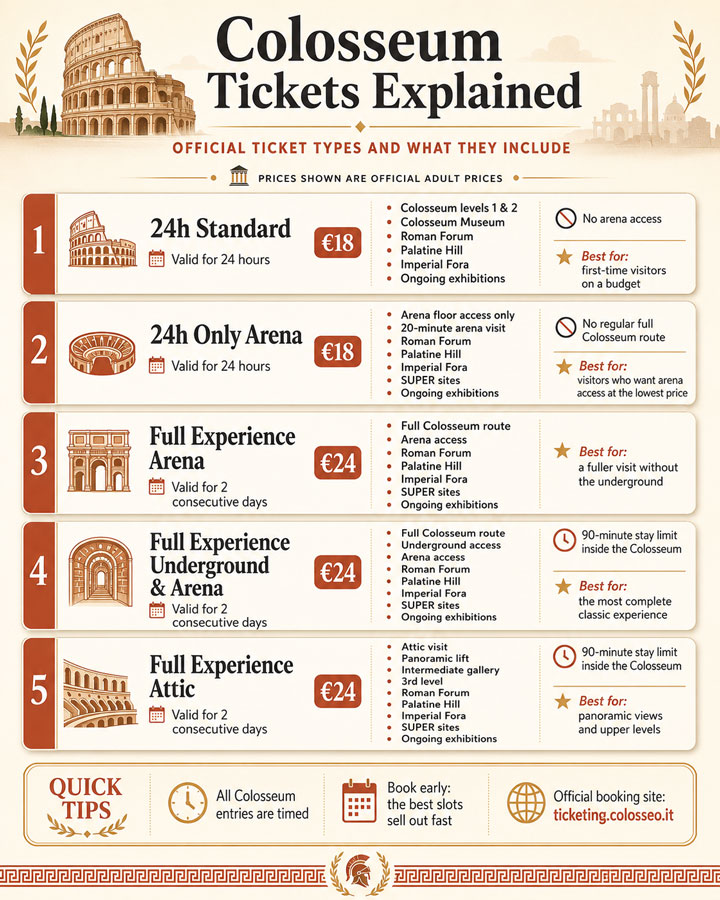
colosseum-tickets-explained

1. 24h Colosseum, Roman Forum, Palatine Hill Ticket

As the standard ticket, you’ll get access to the first and second tier of the Colosseum, getting incredible views of the underground areas and the arena floor. However, this one doesn’t include access to them. It is perfect for seeing the most iconic parts of the Colosseum.

What’s included:

  • Admission to the Colosseum at the booked time
  • Admission to the Roman Forum-Palatine archaeological area and Imperial Forum
  • Entry to any exhibitions in progress at the Colosseum and in the Roman Forum-Palatine archaeological area

2. 24h Only Arena Ticket

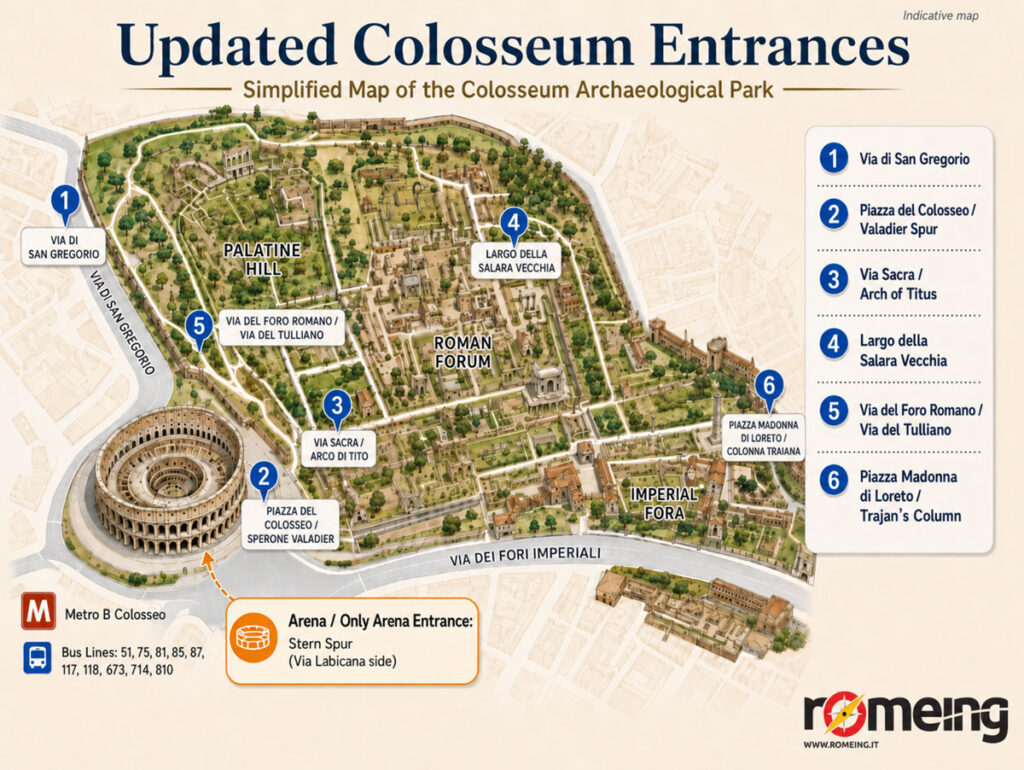
If you are short on time, this one is for you. You’ll enter through the Sperone Stern side, stepping onto the stage of ancient history, but don’t get access to the top tiers. This is ideal for people on a tight schedule or those who’ve already done a full tour.

What’s included:

  • One admission to the Arena floor only at the booked time for a duration of 20 minutes
  • One admission to the Roman Forum-Palatine archaeological area and Imperial Fora
  • Entry to SUPER sites
  • Entry to any exhibitions that may be in progress in the Roman Forum-Palatine archaeological area

3. Full Experience – With Entry to the Arena of the Colosseum Ticket

Different to the standard ticket, this full experience includes access to the arena floor. Step into history and experience the heart of the Colosseum.

What’s included:

  • Admission to the Colosseum at the booked time
  • Entry to the Colosseum Arena
  • Admission to the Roman Forum-Palatine archaeological area and Imperial Fora
  • Entry to SUPER sites
  • Entry to any exhibitions in progress at the Colosseum and in the Roman Forum-Palatine archaeological area

4. Full Experience – Underground Levels and Arena Ticket

For a truly 360-degree unique experience, this ticket lets you explore the hypogeum (the underground chambers where gladiators and animals waited before battle), and the arena as well!

What’s included:

  • Admission to the Colosseum with a permanence period of max 90 minutes
  • Entry to the Colosseum Arena
  • Entry to the Colosseum Underground levels at the booked time
  • Admission to the Roman Forum-Palatine archaeological area and Imperial Fora
  • Entry to SUPER sites
  • Entry to any exhibitions in progress at the Colosseum and in the Roman Forum-Palatine archaeological area

5. Full Experience – With Entry to the Attic of the Colosseum Ticket

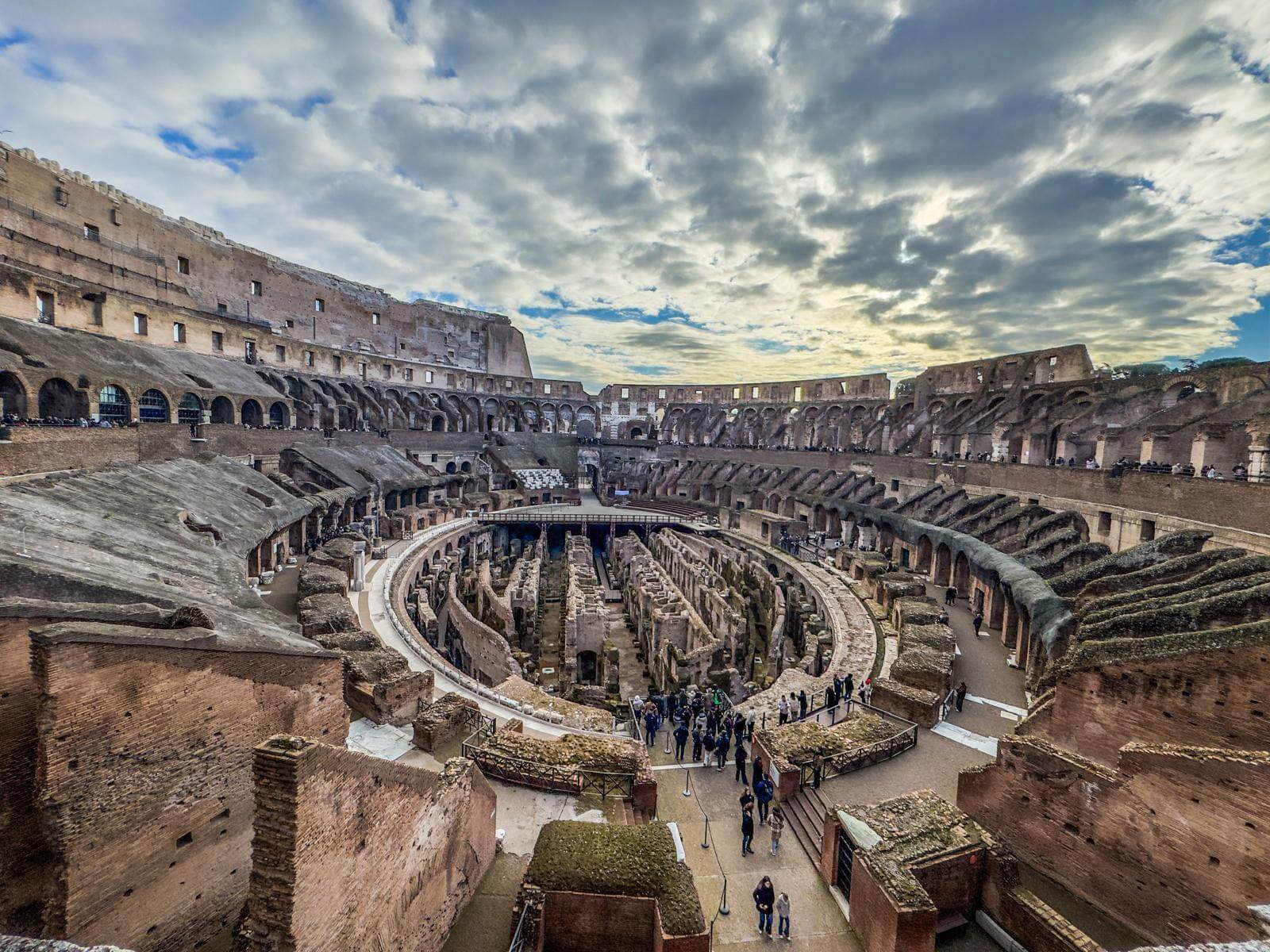
For stunning views of Rome, the Attico Ticket is your go-to. It gives you access to the Attic area with panoramic lift and upper-level views. From here, you’ll enjoy a bird’s-eye view of the entire arena.

What’s included:

  • Admission to the Colosseum
  • Entry to the Attic of the Colosseum at the booked time
  • Admission to the Roman Forum-Palatine archaeological area and Imperial Fora
  • Entry to SUPER sites
  • Entry to any exhibitions in progress at the Colosseum and in the Roman-Palatine archaeological area

6. Forum Pass Super

If you have visited the Colosseum before, and you are looking to explore deep into the Roman Forum and Palatine this time, this one is for you!

What’s included:

  • Admission to the Roman Forum-Palatine archaeological area and Imperial Fora
  • Entry to SUPER sites
  • Entry to any exhibitions in progress at the Roman Forum-Palatine archaeological area

7. Night Tour Ticket

If you’re looking for a magical experience, the Night Tour Ticket is usually available from May to November. It’s a unique way to explore the Colosseum under the moonlight.

Ticket prices vary depending on the experience you choose and where you buy them. To book your tickets, visit the official Colosseum website (ticketing.colosseo.it) or verified tour agencies. Getting a ticket can be challenging, especially during high-demand months. But here’s an easy solution: consider booking a guided tour

Why Booking a Guided Tour of the Colosseum is a No-Brainer
book-colosseum-tour

Imagine stepping in the same footsteps as ancient Romans, gladiators, and emperors. A once-in-a-lifetime chance to immerse yourself in history. But all you see are old ruins, missing a storyteller to bring them to life. 

The expertise that comes in handy with a professionally guided tour allows you to dive deep into the hidden gems that are mostly overlooked. Palatine Hill and the Roman Forum are the home of some of the most astonishing wonders of the archaeological park: the Roman Senate, the Santa Maria Antiqua Church, and the House of Livia (yes, Augustus wife). You do not want to miss out hearing the rich history of these timeless marvels.

A professional guide will point out the gems, making you see beyond the Colosseum, further exploring the heart of ancient Rome. Plus, your guide is there to offer tips on where to eat, drink, and rest, ensuring that your entire experience is smooth and memorable.

Also, let’s face it: buying tickets on your own can be a headache. From long lines to ticket availability, booking a guided tour takes the stress out of the equation. With a professional guide, you don’t have to worry about tickets, as they are taken care of for you. 

Super Sites

Colosseum SUPER sites are 8 exclusive, carefully curated areas within the Roman Forum and Palatine Hill that offer enhanced, immersive experiences. Using features like lightmapping and video projections, these sites bring history to life. Some highlights include the House of Augustus, Santa Maria Antiqua, and the Domus Tiberiana.
The Power of a Guided Colosseum Experience

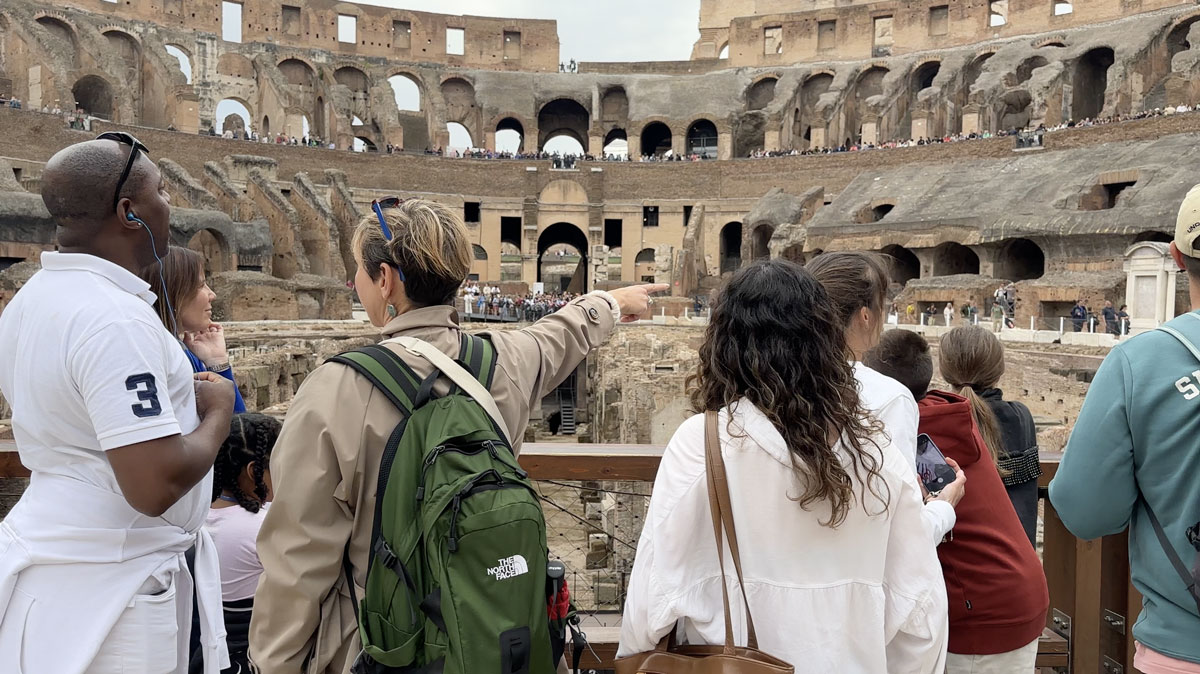
Recently, I had the chance to visit the Colosseum Archaeological Park with a tour guide (shout out to them!), and I can honestly say it was one of the most enriching experiences of my life. I’ve been living in Rome for four years and have visited the Colosseum a few times before. But this time, for the first time, I left with a deep sense of accomplishment, having learned so much about the cobblestones, columns, and frescoes I had been walking through.

Roman Forum
roman-forum-tour
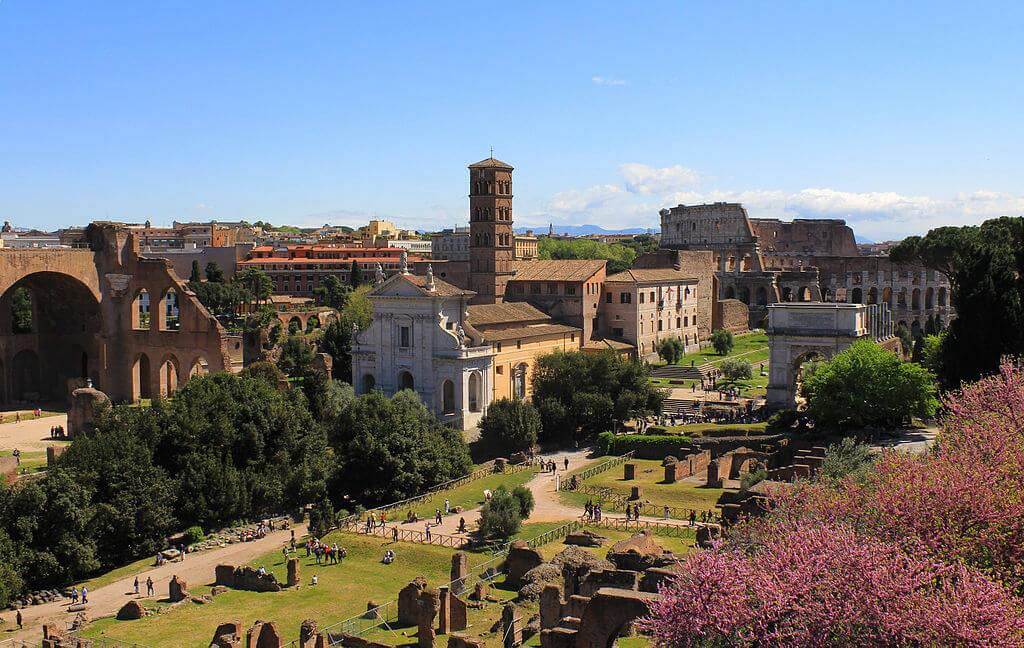
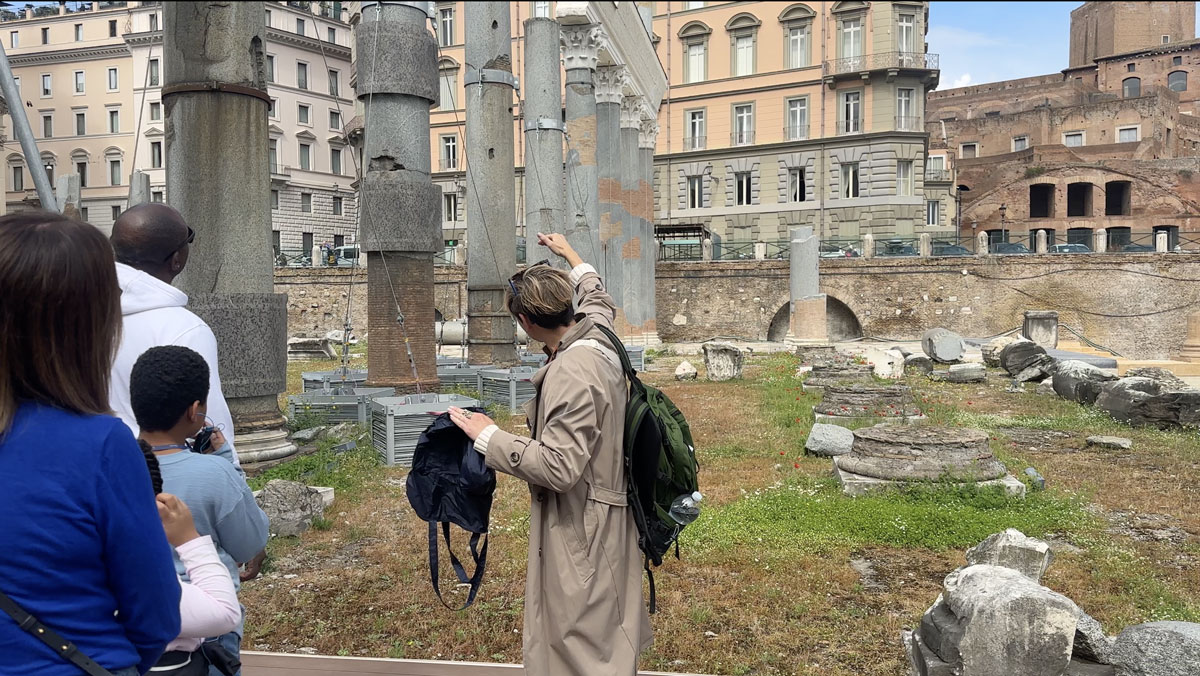
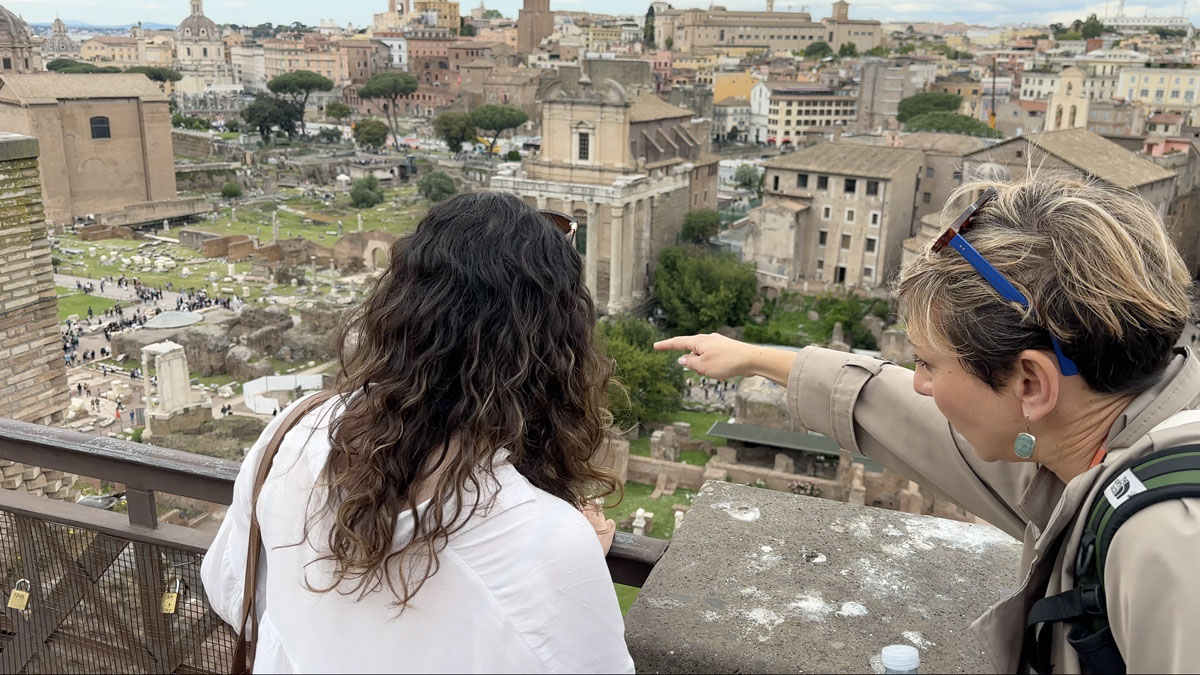
view of the roman forum

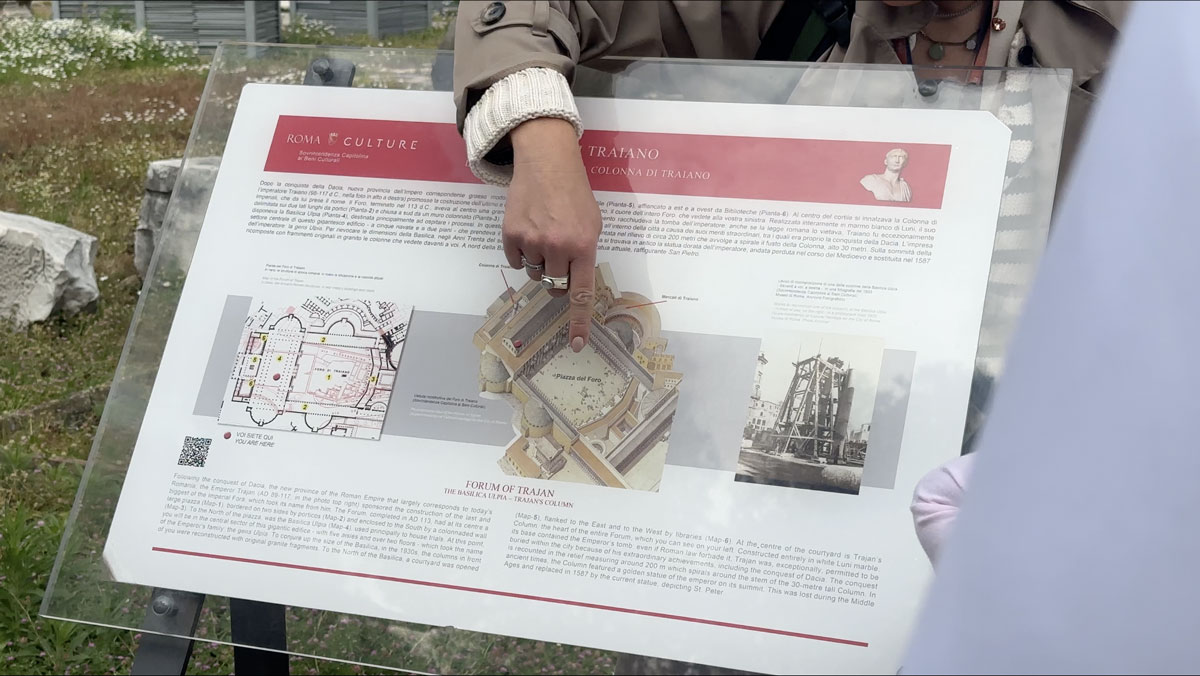
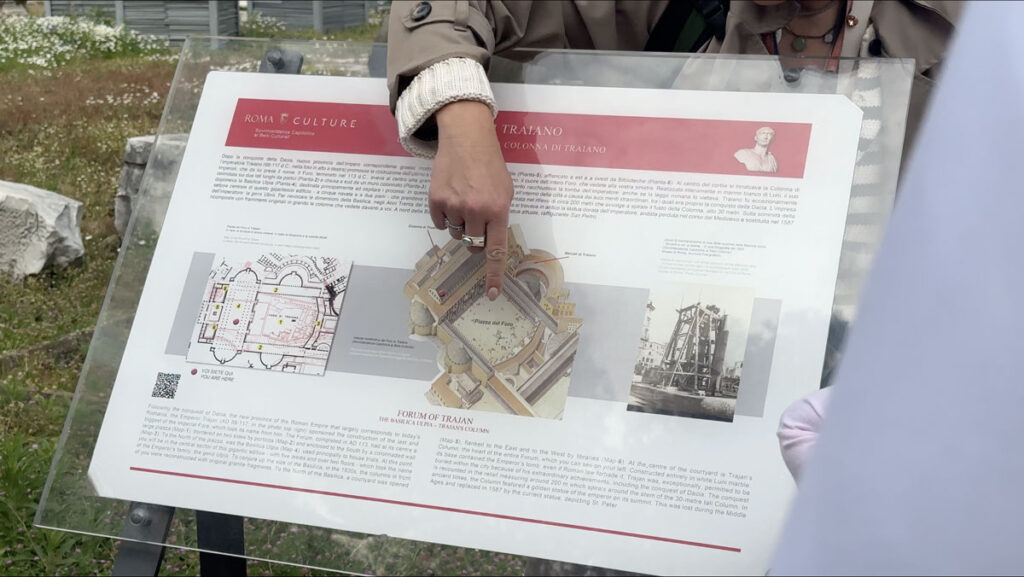
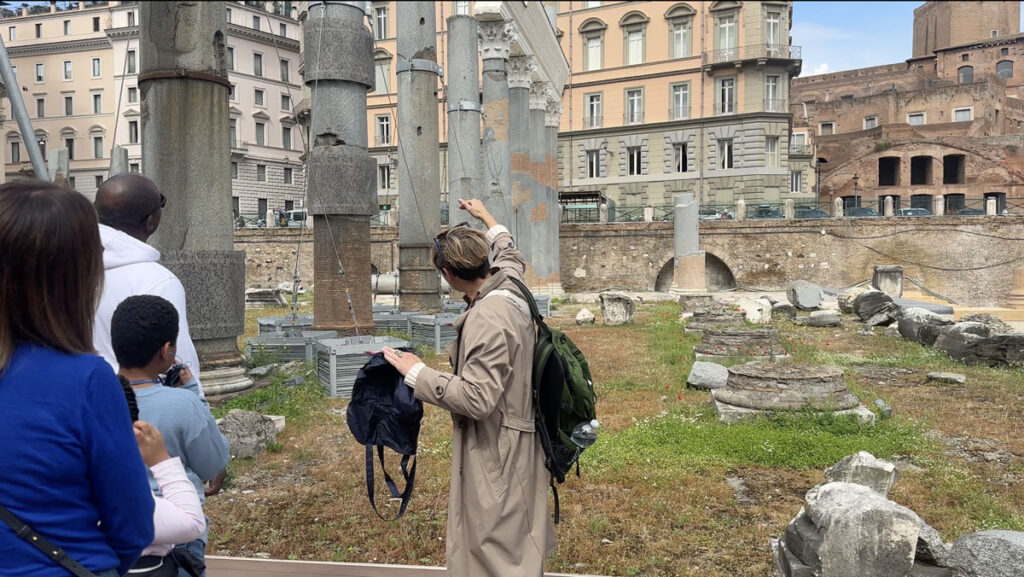
We began our tour of the Roman Forum at Trajan’s Column, a legendary Roman monument built in 113 AD, topped with a statue of St. Peter, the patron saint of the city. As we walked through this ancient site, we learned about how the city was once 20 meters lower than it is today due to centuries of flooding. Everything we see in the park is the result of the work of dedicated archaeologists, who have dug deep into the earth to uncover the hidden history beneath the modern Roman cobblestones. These pieces of the past are carefully unearthed and brought back to life, allowing us to connect with ancient Rome in ways we never thought possible.

As we made our way to Via Sacra, we heard the legendary stories of the Temple of Saturn and the House of the Vestal Virgins, the sacred residence where six young virgins were entrusted with maintaining the eternal fire of the Roman Empire.

Palatine Hill
palatine-guided-tour
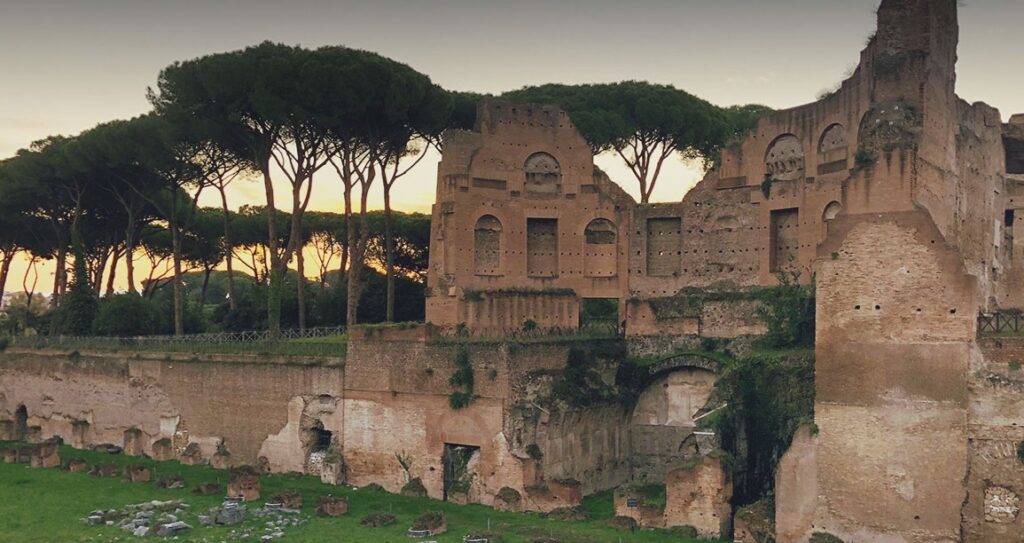
palatino

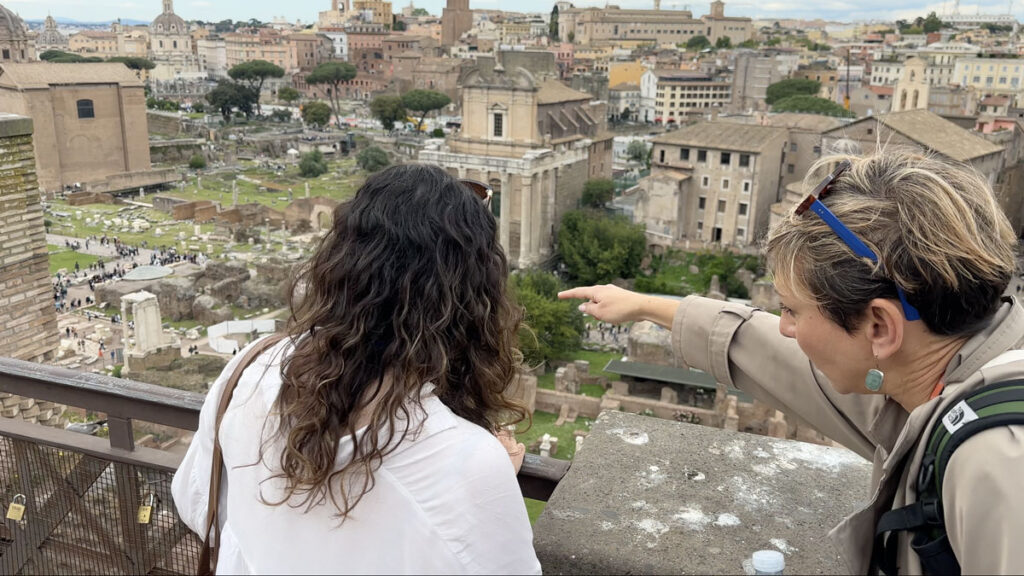
At the foot of Palatine Hill, we entered the Church of Santa Maria Antica, home to some of the most beautiful frescoes that offer a glimpse into early Christianity in ancient Rome. The walls of the sanctuary are adorned with vibrant depictions of the Virgin Mary and infant Jesus, as well as saints and martyrs.

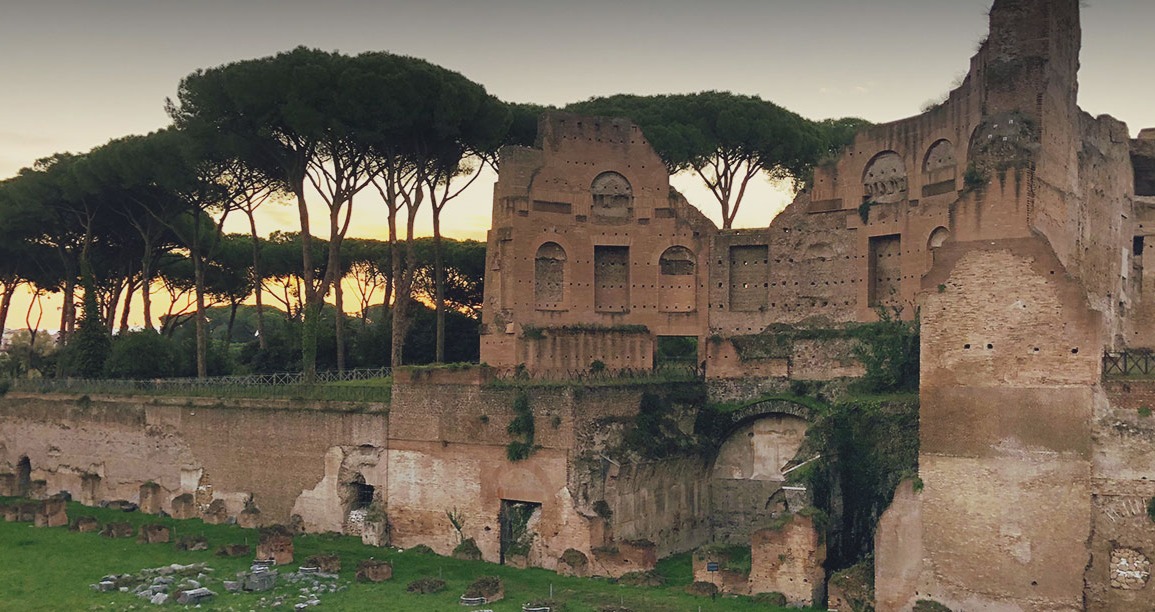
Continuing through, we reached a luxurious Roman domus (house) and then ascended to the Palatine Hill. This spot offers the most breathtaking panoramic view in Rome, overlooking the Roman Forum, the Colosseum, and the Vittoriano Monument. Palatine Hill is not only a place of beauty but also of romance. One of its most famous features is the Farnese Gardens, a stunning historical garden with a rich past that’s definitely worth visiting. The tranquil beauty and significance of this garden make it a must-see, offering a unique escape from the hustle and bustle of the city.

Colosseum
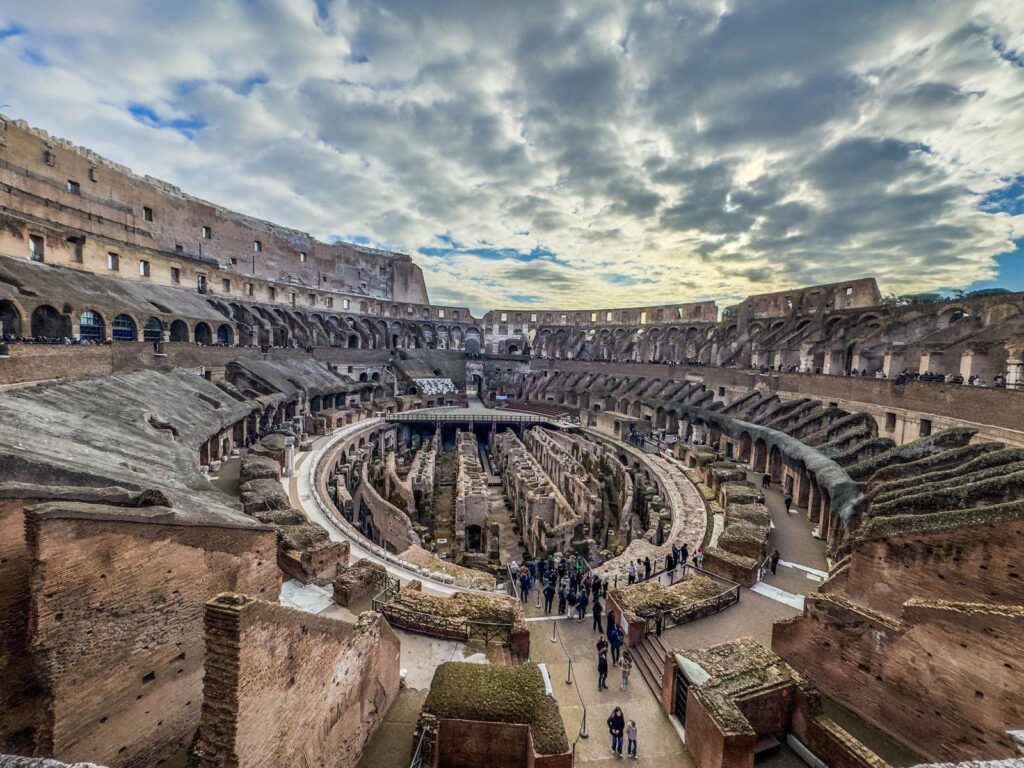
colosseum-tour
Colosseum Tickets vs Guided Tours: The Best Way to Visit Rome’s Iconic Amphitheatre

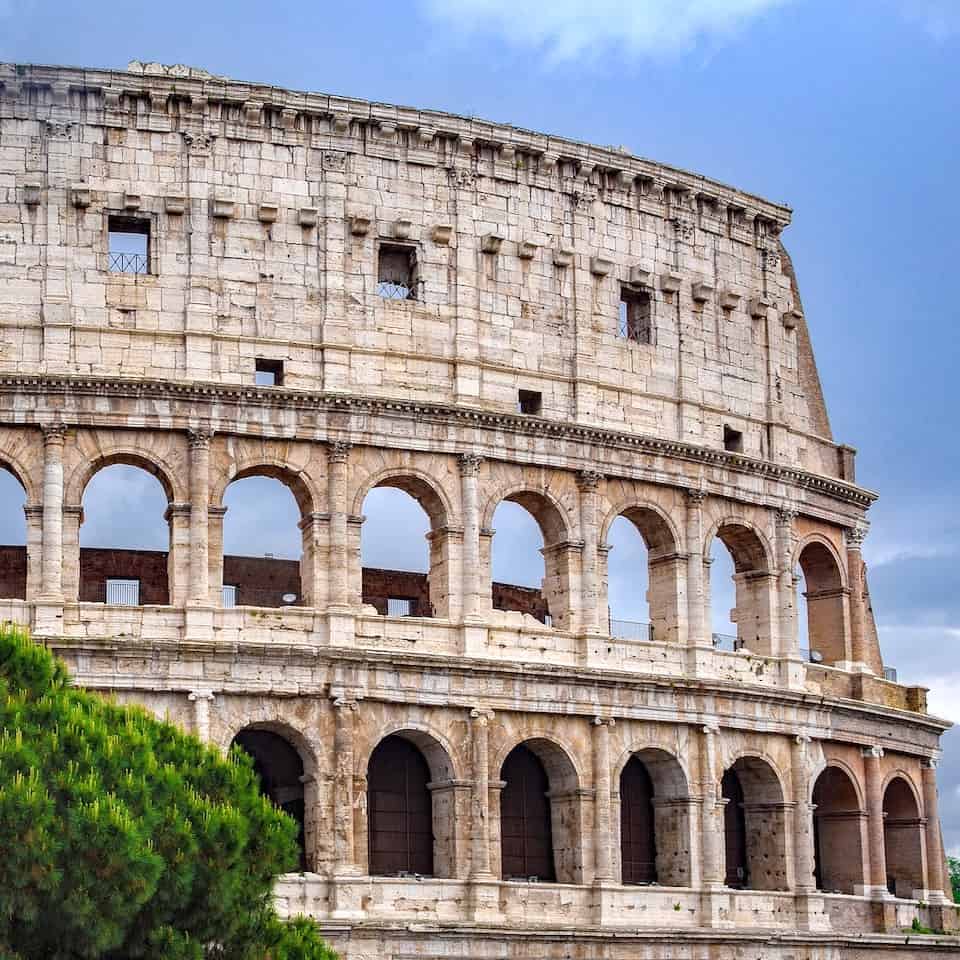
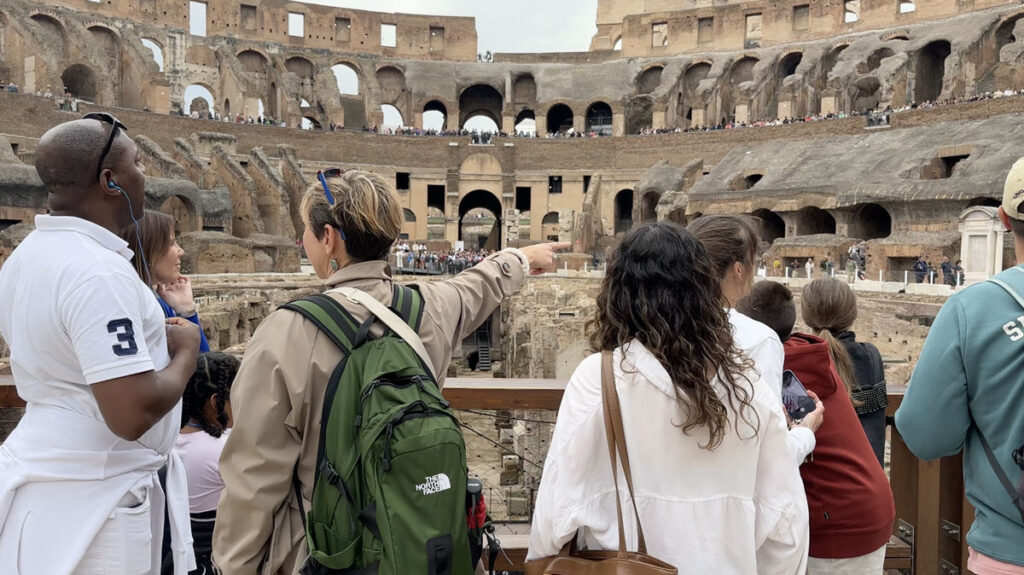
We wrapped up our tour at the Colosseum, where we had arena tickets, allowing us to access the heart of the structure first. Walking through the arena felt like stepping into a scene from a gladiator movie. Entering this majestic monument, one of the new 7 Wonders of the World, was an awe-inspiring moment. The entrance was smooth and quick, and our guide gave us a detailed explanation of the fascinating history of the animals, heroes, anti-heroes, slaves, and gladiators who once took center stage here. We learned about the Romans who filled the stands to watch these spectacular and brutal events, and even more intriguing to me, what happened to the Colosseum after the Roman Empire was gone. We then made our way to the second tier for a better view, where our guide continued to share the rich and sometimes tragic history of this mystical place

The tour concluded with a sense of awe, ready to unwind with a well-deserved Aperol Spritz.

Some extra Tips for your Colosseum day!
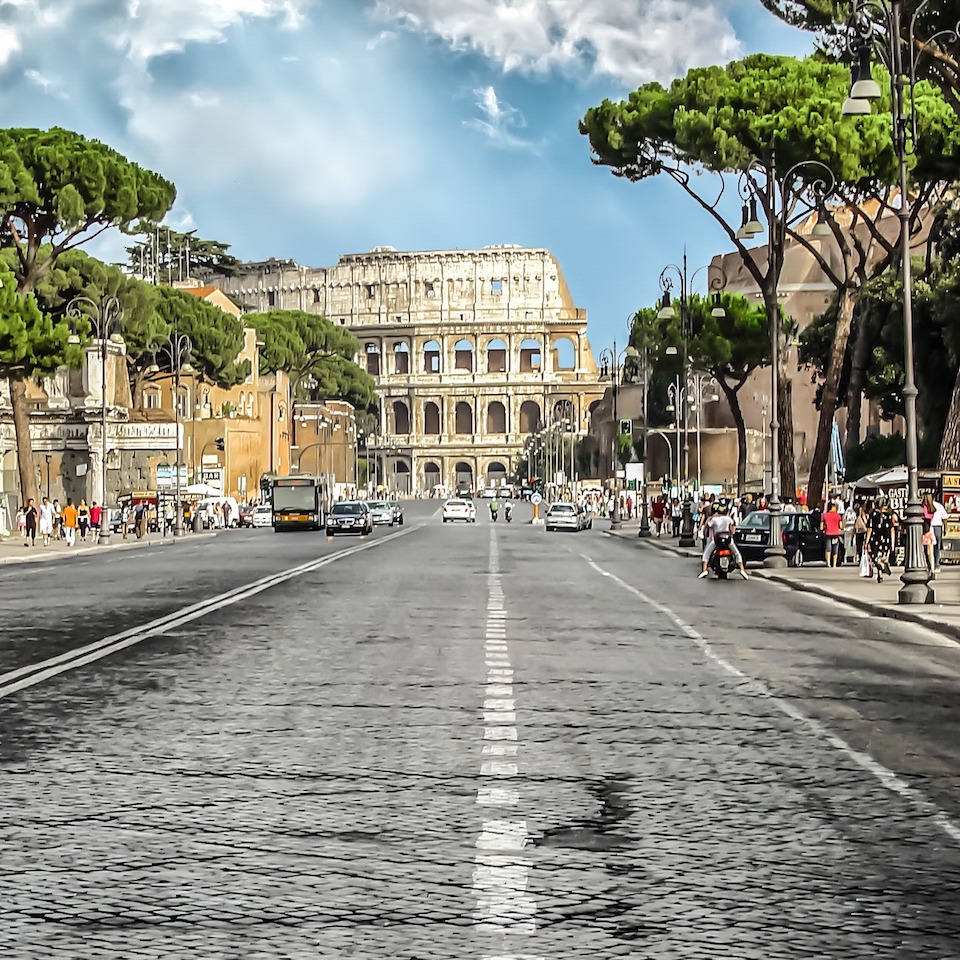
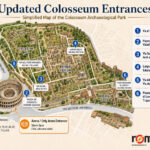
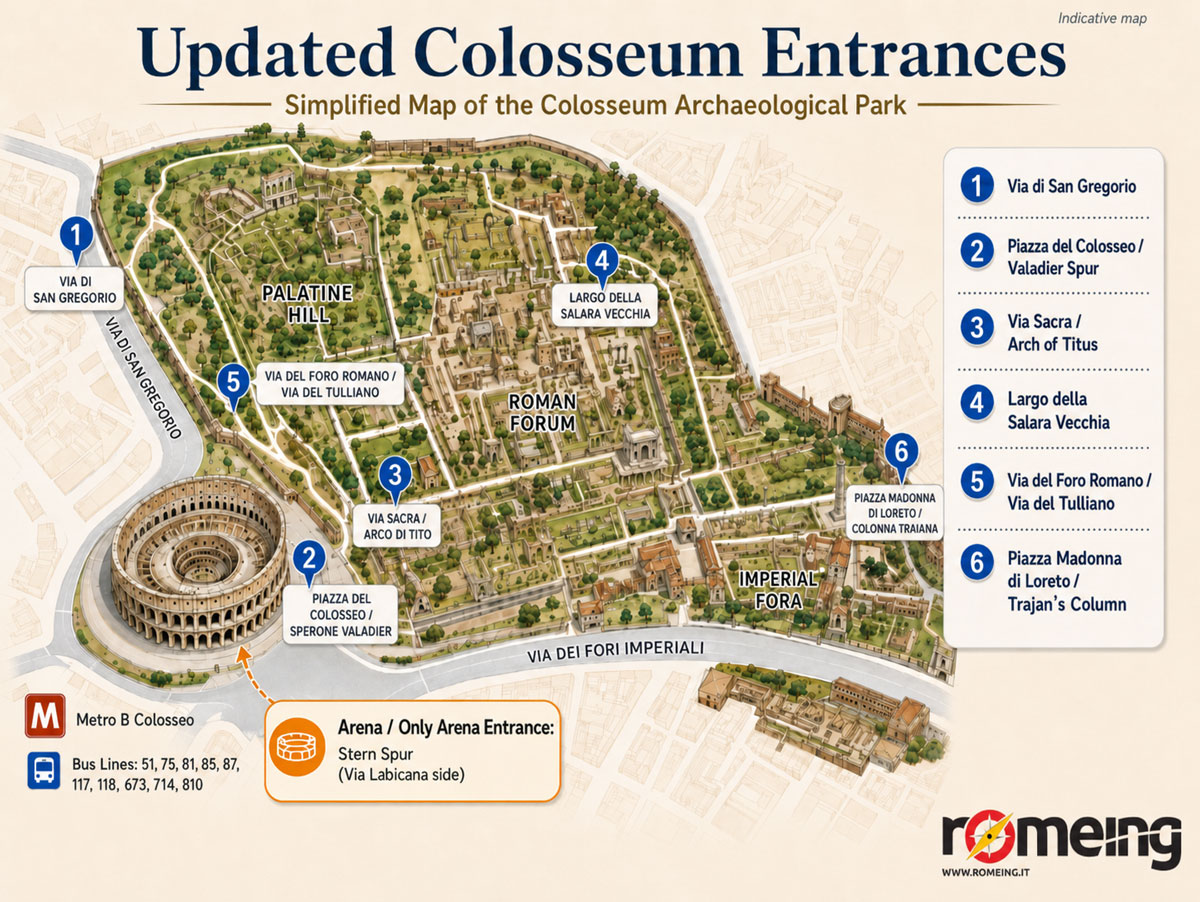
Colosseum-Entrances

Here are some extra essential tips to make your experience smoother, more enjoyable, and stress-free!

1. Beat the Heat: The park is vast, so wear comfortable shoes, a hat, and don’t forget sunscreen. Avoid Midday Sun. Summer midday heat can be brutal. It’s best to visit early in the morning or later in the afternoon. There are 8 water fountains around the park, so bring your bottle and stay hydrated. No need to buy overpriced water!

2. Skip the Crowds (But Not the Lines!): First Sundays of the month, entrance is free, but it’s chaotic. The Colosseum gets packed, and it’s tough to explore peacefully. Colosseum tickets have a specific time slot for entry. Once you’re in, you can stay max 75 to 90 min. So be mindful of your time! You can visit the Roman Forum and Palatine Hill at your leisure, but you can only enter once. Groups and individuals have separate entrances, but there’s no “skip the line” except for buying tickets on-site.

3. Bathroom Breaks: There are only 5 bathrooms in the entire park: one at the Colosseum, one at Palatine Hill, and the rest spread through the Forum. Plan ahead!

4. Get the Best Path: Guides offer the best routes to navigate the Forum and Colosseum. For maximum flexibility, consider booking a private tour.

5. Accessibility: The Roman Forum is tough to navigate for wheelchair users. However, inside the Colosseum and at some points of the Roman Forum, there’s an elevator for easier access. Visiting can be physically demanding, so it may not be the best experience for pregnant women. We recommend booking a private tour to enhance comfort and make your visit more enjoyable.

6. Snacks and Drinks: There are vending machines at Palatine Hill and the Colosseum, so you can grab a quick snack or drink during your tour.

Where to Go Once You’ve Conquered the Colosseum

Wondering where to go after exploring the heart of ancient Rome? Let us guide you to Monti, the charming neighborhood just steps from the Colosseum. Here, you’ll find the perfect spots to unwind with a bite or a drink, wrapping up your Colosseum adventure in the best way possible!

The post Colosseum Tickets vs Guided Tours: The Best Way to Visit Rome’s Iconic Amphitheatre appeared first on Romeing.

Hokusai. The Great Master of Japanese Art

An intimate exploration of the life and work of Hokusai, one of the most revered and influential japanese artists of all time.

From March 27 to June 29, in the heart of Rome, Palazzo Bonaparte will host an extraordinary exhibition showcasing 200 pieces by the timeless Japanese artist Katsushika Hokusai (1760–1849), on loan from the renowned National Museum in Krakow.

Hokusai stands out as a central figure of the Edo period (1603–1868), a time when the Floating World culture of Ukiyo-e flourished and later deeply influenced both Japanese and Western art. 

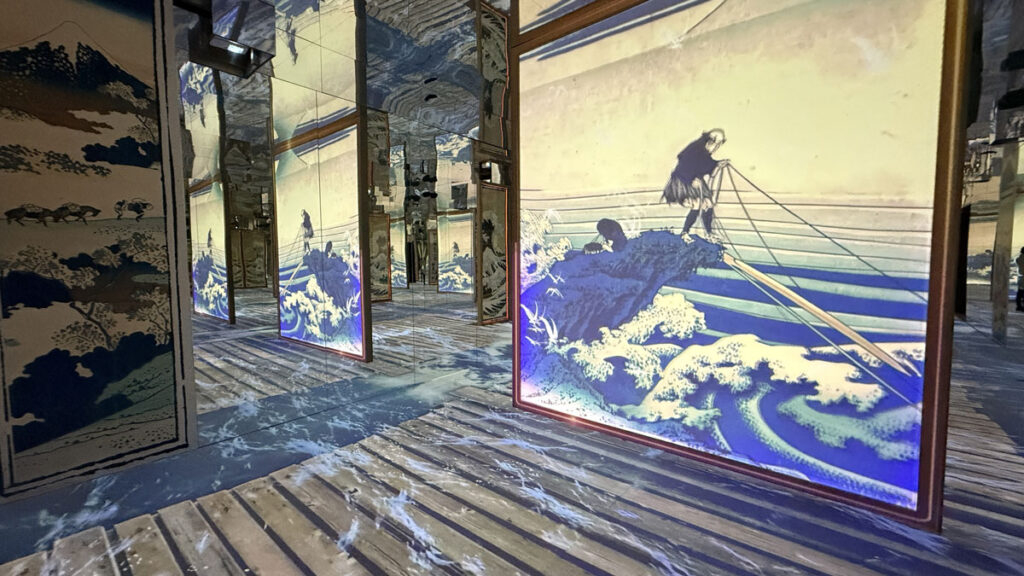
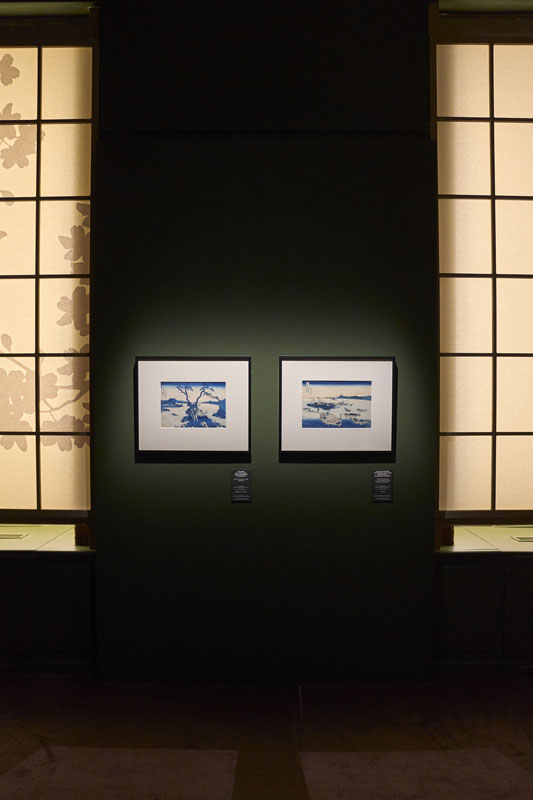
The exhibition is divided into two floors, tracing Hokusai’s journey through 1800s Japan and composing a visual dialogue with his iconic works, including The Great Wave off Kanagawa, his serene Thirty-Six Views of Mount Fuji, and his revolutionary sketchbook series Manga

hokusai-rome

Hokusai’s Eternal Landscapes

Nature was Hokusai’s lifelong muse. The first floor of the exhibition transports visitors to 1800s Japan, offering a glimpse into the artist’s evolution in his tireless experimentation with form, technique, and narrative. As a lover of his land, Hokusai’s early pieces, such as The Fifty-Three Stations of the Tōkaidō, portray his deep reverence for his country and its landscapes. 

Visitors are invited to witness how his observation of nature goes beyond mere representation, as he not only captures its physicality but also its emotional dimension.

Ultimately, what is profoundly compelling is Hokusai’s ability to capture human life and merge it with nature. In many of his works, such as View of Mount Fuji from Lake Suwa Shinshū Suwa-ko, the sacred mountain shares the canvas with humble human-built structures. While Mount Fuji often recedes into the background, it is the human presence that emerges on the canvas, magnifying Hokusai’s sensitivity to life. 

As a prodigy of observation, Hokusai’s creative arc led him to explore plants, seasons, animals, human figures, and all in between, ultimately constructing eternal landscapes. 

hokusai-palazzo-bonaparte

The Great Wave off Kanagawa

It was only after turning seventy that he created some of his most famous masterpieces, including his most iconic image: The Great Wave off Kanagawa.

Known as his most renowned piece, it symbolizes the destructive power of nature against humanity’s fragility (small fishing boats), while the delicate strokes that shape pieces of Mount Fuji reveal a profound harmony between humanity and the natural world. The piece serves as a metaphor for Japan’s vulnerability to foreign, Western influences during a time of a self imposed isolation. 

It is part of the Master of Water series, which showcases Hokusai’s ability to depict the fluidity and movement of water in all its forms. The exhibition reveals how Hokusai could capture the infinite variations of the element, with no two shapes alike in the entire series. 

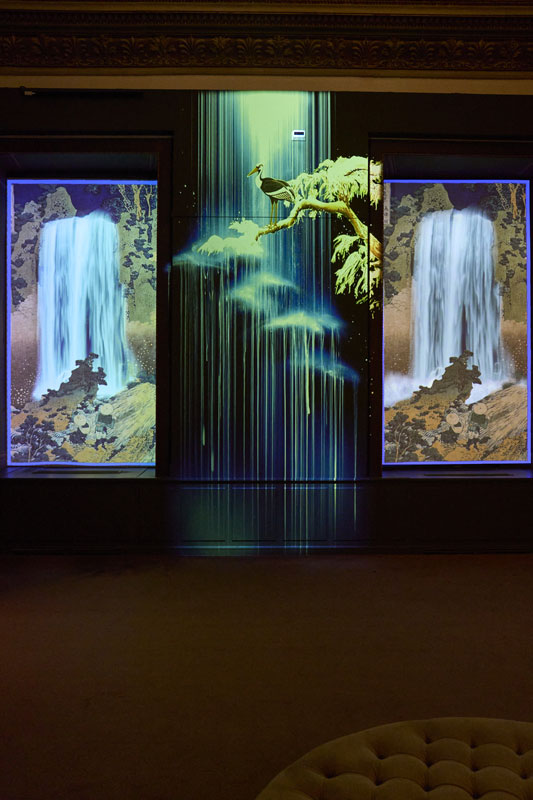
Water is explored in depth throughout the first part of the exhibition. The series “A Journey Among the Waterfalls of Various Provinces” conveys a dynamic rhythm through Hokusai’s exceptional brushwork, transforming nature into an elegant flow of energy.

hokusai-palazzo-bonaparte

The Old Man Mad About Painting (“Gakyō rōjin”)

In his later years, he often signed his works as “Gakyō rōjin,” meaning “Old Man Mad About Painting,” a name that reflects his way of observing the world and reinventing it through his drawing. 

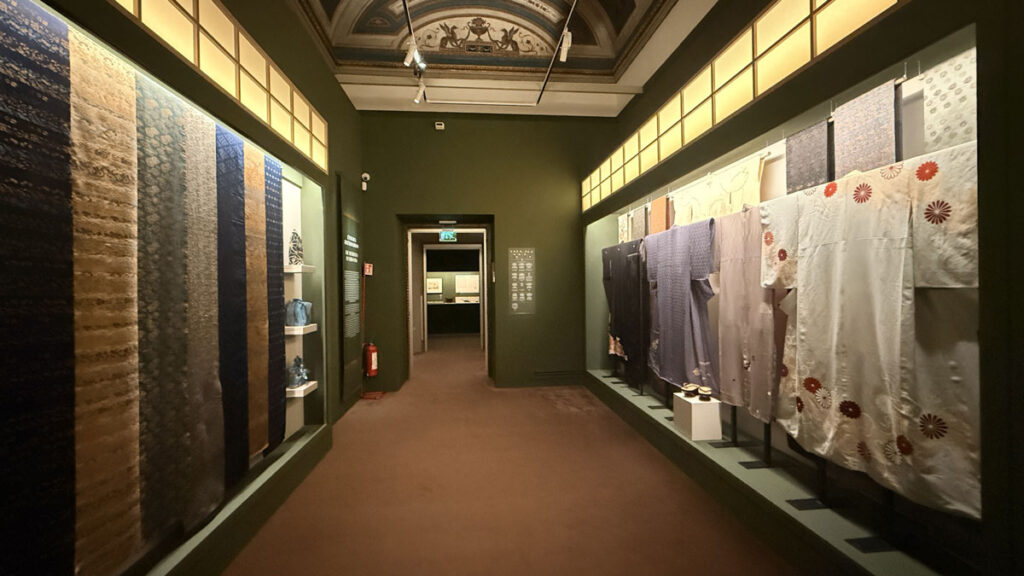
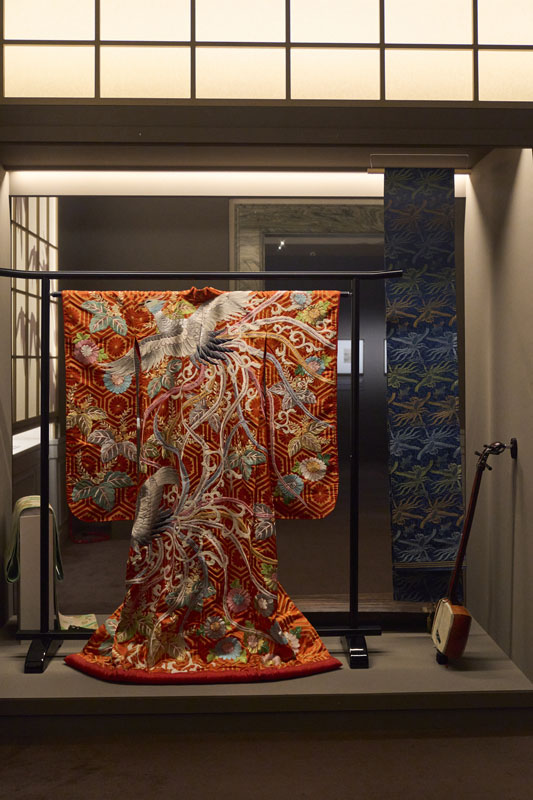
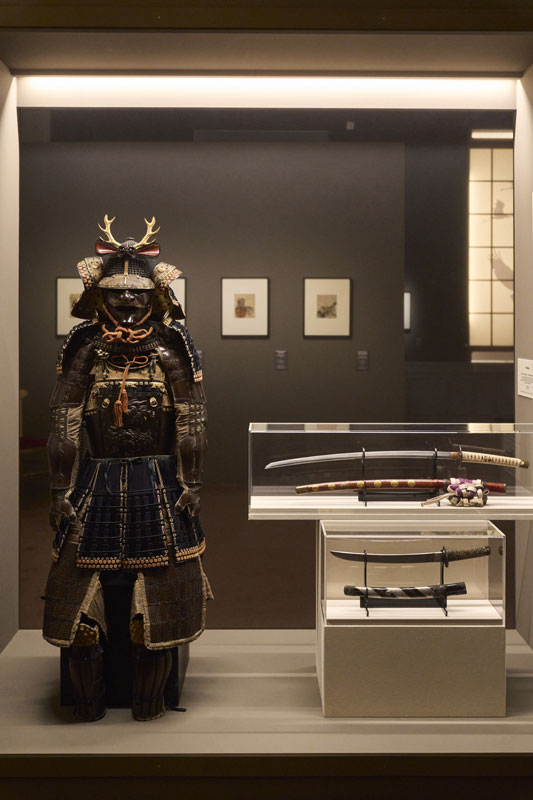
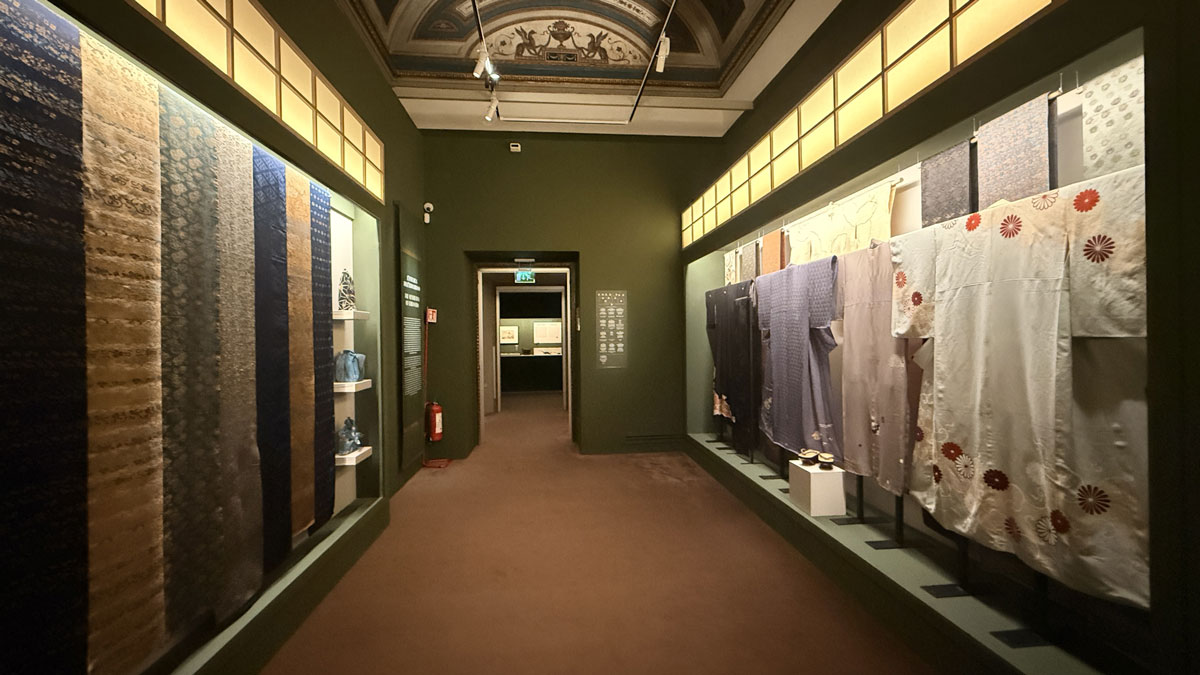
The second floor of the exhibition shifts focus to the rich cultural, spiritual, and literary side of 1800s Japan.  Here, visitors are immersed in its myths, legends, and folklore, brought to life through his work alongside over 180 pieces, including rare books and valuable Japanese objects such as kimonos, travel accessories, armor, helmets, swords, and traditional musical instruments. 

Visitors will encounter fascinating scenes in the series One Hundred Ghost Stories ,with each piece underscoring the deep connection between Hokusai’s work and Japan’s cultural heritage.

This part of the exhibition also reveals lesser-known facets of Hokusai’s character, such as his wit and playful spirit. In “Self-Portrait as a Fisherman,” a refined surimono print in which the artist humorously engages with his own image, offers a glimpse of his lighthearted side.

hokusai-palazzo-bonaparte

Manga 

In the art world, Hokusai is known as the father of Manga, a genre of Japanese comics that evolved from simple sketches into a respected art form. He created a 15-volume collection that reveals his innovative approach to visual storytelling. 

The exhibition showcases some of his most celebrated manga, shedding light on how his restless experimentation and his desire to communicate complex ideas through drawing. 

A Lasting Legacy 

The exhibition is further enriched with a different perspective on 19th-century Japan through the photographs of Italian traveller and photographer Felice Beato, who was among the first to document the country as it opened up to the West. 

Beato’s images, presented in a video that tells his life story and artistic journey, portray landscapes, cities, and scenes of daily life, creating an ideal extension of the dialogue with Hokusai’s visual universe.

Hokusai’s influence on Western artists, including Claude Monet, Van Gogh, and even composers like Claude Debussy, is evident in the way he redefined what art could be beyond observation, and how it could communicate the connection between the beauty of nature and the depth of the human figure.

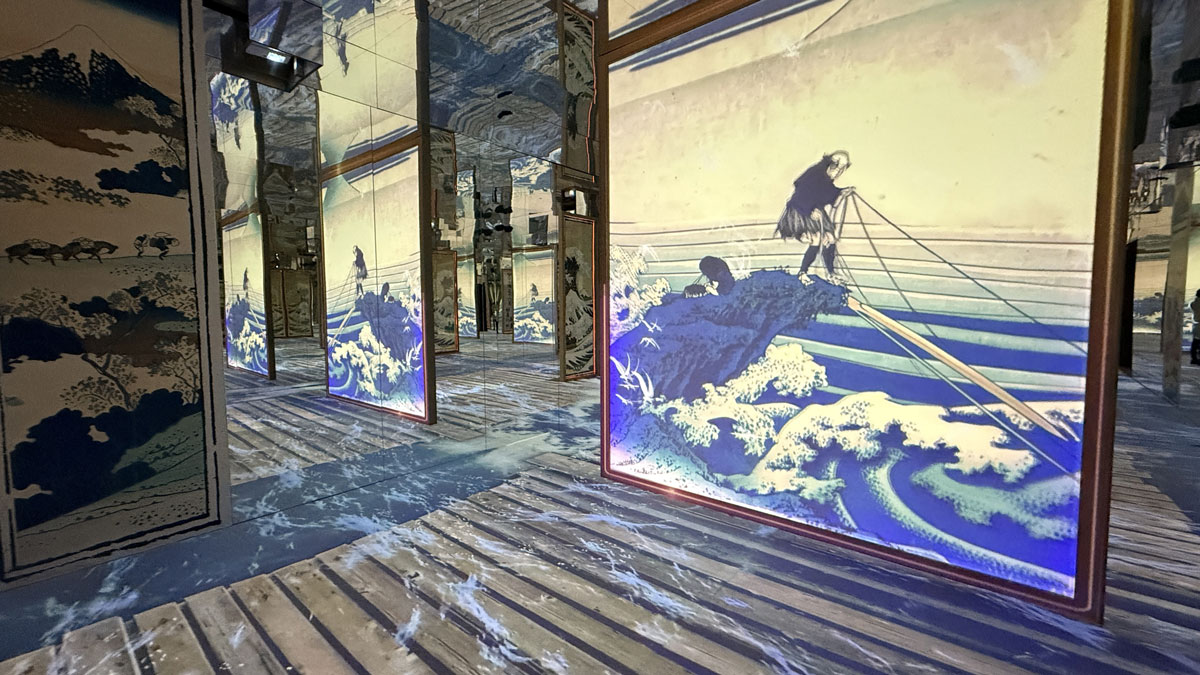
The exhibition also features an immersive installation inspired by Hokusai’s Great Wave, which aims to challenge each visitor to face their own wave eye to eye. 

The post Hokusai. The Great Master of Japanese Art appeared first on Romeing.
The best events in Rome this spring 2026

What’s on in Rome this Spring: events to mark on your calendar

Spring is one of the best times you can visit Rome. The weather is beautiful and milder than the summer months, there are fewer tourists, and the city is lively. The flowers are blooming, and everyone has that fresh pep in their step. You’ll definitely want to get out and see the sights, especially because there will be fewer tourists, but of course, you’ll want to check out some events, as springtime in Rome is filled with them. As we’re getting closer to spring, the official 2026 Rome spring event dates are being announced.

Spring Exhibitions in Rome

Impressionism and Beyond. Masterpieces from the Detroit Institute of Arts

The eternal city is known for greatness in many areas, a prominent one being art. Rome is home to countless museums and art galleries. As a hub for global art, Rome has everything from ancient classical art to leading contemporary art. Some exhibitions you should check out in Rome this spring are: 

There are countless opportunities to see one of a kind art in Rome this spring and these are some must see highlights. Go enjoy!


Run Rome The Marathon

March 22
Starting from Via Dei Fori Imperiali

rome marathon

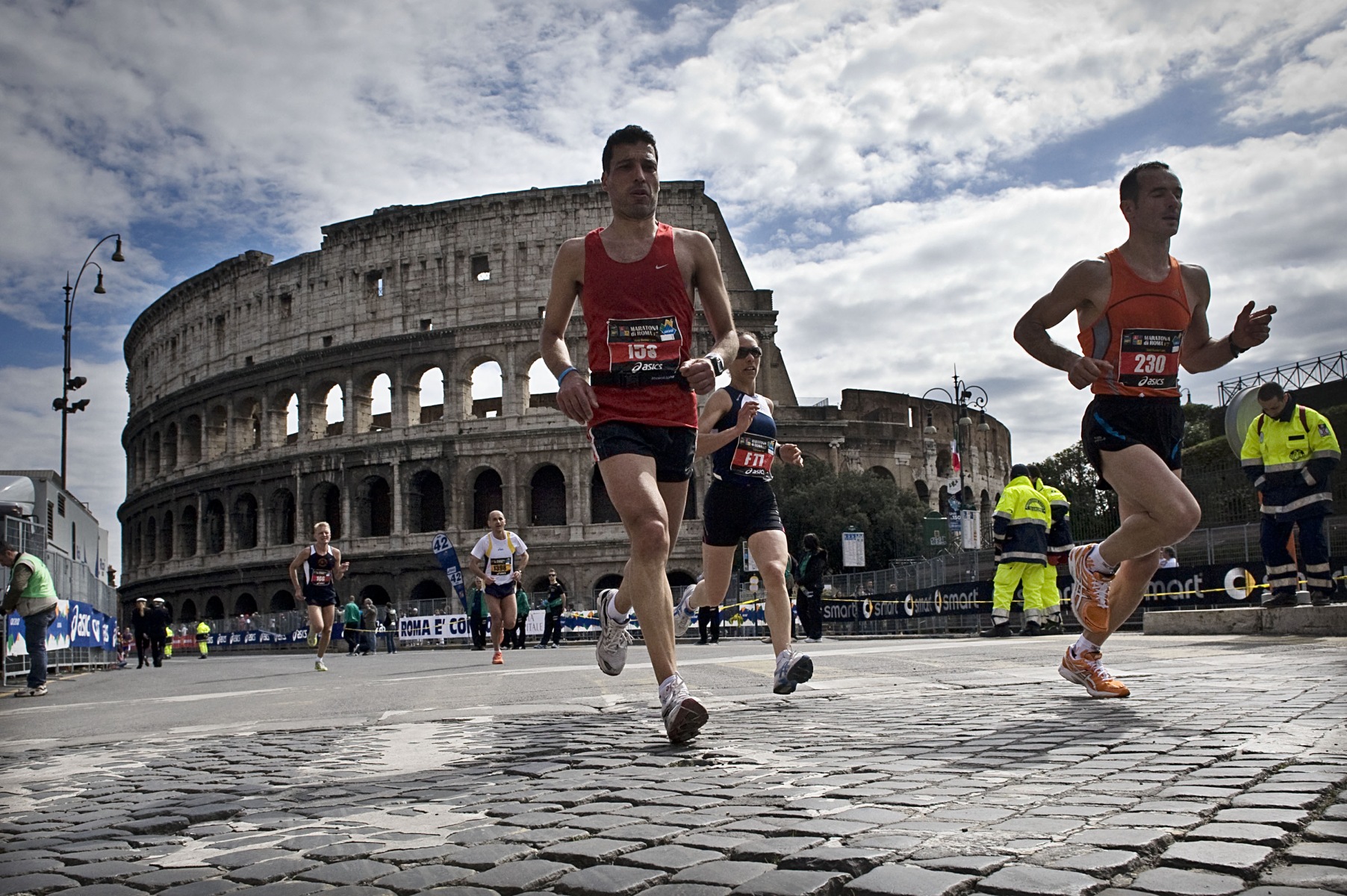
The 31st edition of Rome’s Marathon will take place on March 22. This year the route will start from the Fori Imperiali and the Colosseum and will finish at the Circo Massimo. Participants will embark on a 26 mile journey where they will pass St. Peter’s Basilica, Castel Sant’Angelo, Foro Italico, Piazza del Popolo, the Theater of Marcellus, and the Arch of Constantine. This event is not only open for experienced runners, but also those who simply enjoy running or those who want to challenge themselves.

Read more


Open House Rome 

May 16 – 24
Various locations

Open House Roma 2019

For a rare peek inside of Rome’s architectural and design wonders, make sure to check out some of the events during Open House Rome. Open House Rome was created by a group of architects and communicators focused on social and cultural innovation. This annual event, held over nine days, celebrates design and architecture in the capital. Around 200 sites, from all eras and usually closed to the public, open their doors for free guided tours—a unique chance to see Rome from a new perspective!

Read more


BNL International Tennis Tournament

April 28 – May 17
Foro Italico

Internazionali di Tennis

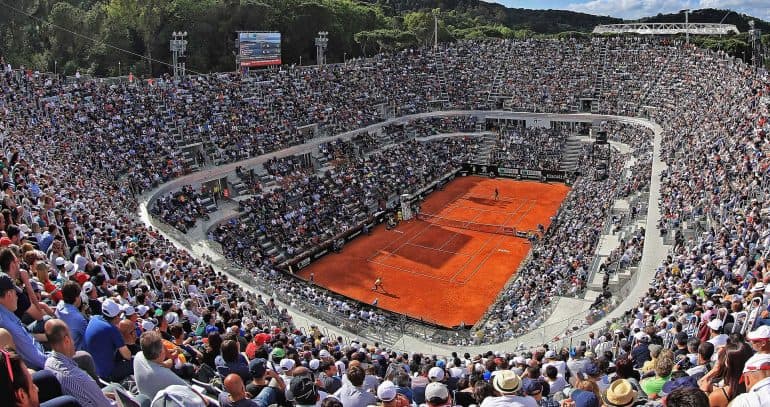
The BNL International Tennis Tournament is not to miss, even for those not as familiar with the sport. Top names in the game compete every year in this prestigious, glamorous competition. Aside from the competition itself, there is fantastic food, shopping, and celebrity performance surrounding the events.

Read more

Discover our selection of the best
Rome’s Tours & Local Experiences

VISIT OUR MARKETPLACE


Spring Attitude Festival

May 29 – 30
La Nuvola

spring-attitude-festival

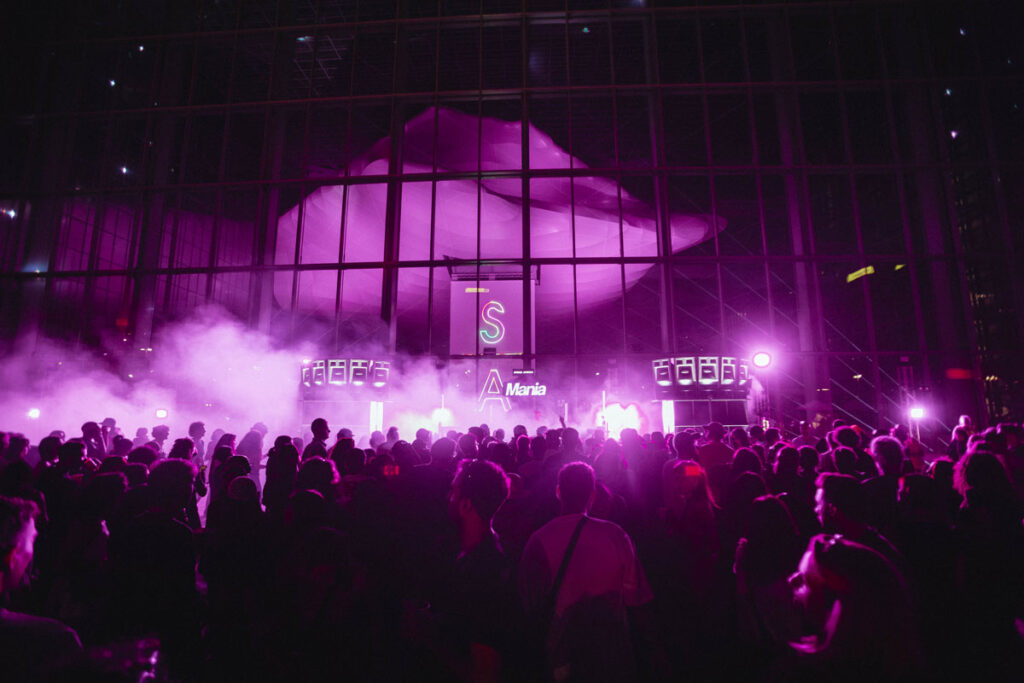
Spring Attitude Festival returns to Rome on May 29 and 30, 2026 for its 15th edition, once again taking place at La Nuvola. Dedicated to contemporary music, new sounds, and digital arts, the festival brings together two days of live performances and DJ sets spanning electronic, indie, and alt-pop, with a lineup that mixes established international and Italian artists with emerging voices.

Read more


Piazza di Siena International Horse Show

May 27 – 31
Piazza di Siena, Villa Borghese

Piazza di Siena International Horse Show Rome
CSIO Roma 2018 – Rolex GP Roma – Giulia Martinengo Marquet on Verdine SZ
– Roma, Piazza di Siena, 27 May 2018 – – ph.Mario Grassia/FISE

For four days in May, you can watch some of the world’s greatest equestrians take part in competitions of show jumping, traditional riding, and polo matches. Some of the most magnificent horses in the world will gather in the beautiful Villa Borghese alongs with some of the world’s most lavish upper crust. If you’re looking for class, you have no choice but to attend.

Read more

The post The best events in Rome this spring 2026 appeared first on Romeing.
American Student’s Life Saved in Rome After Urgent Liver Transplant

A semester abroad took an unexpected turn when a John Cabot University student developed acute liver failure and was saved by an urgent transplant in Rome

Studying abroad is meant to be a journey of discovery, adventure, and self-growth. But for 21-year-old Lucy McGovern from Seattle, her semester in Rome took an unexpected and life-altering twist.

What began as an exciting chapter in the eternal city quickly turned into a race against time, revealing the importance of quick medical response and the support available for international students far from home.

After arriving in Rome in January, Lucy began feeling unusually tired. At first, she assumed it was simply part of the adjustment that comes with change. But during a weekend trip to Budapest, her condition worsened dramatically: she became extremely fatigued, and her skin and eyes turned yellow.

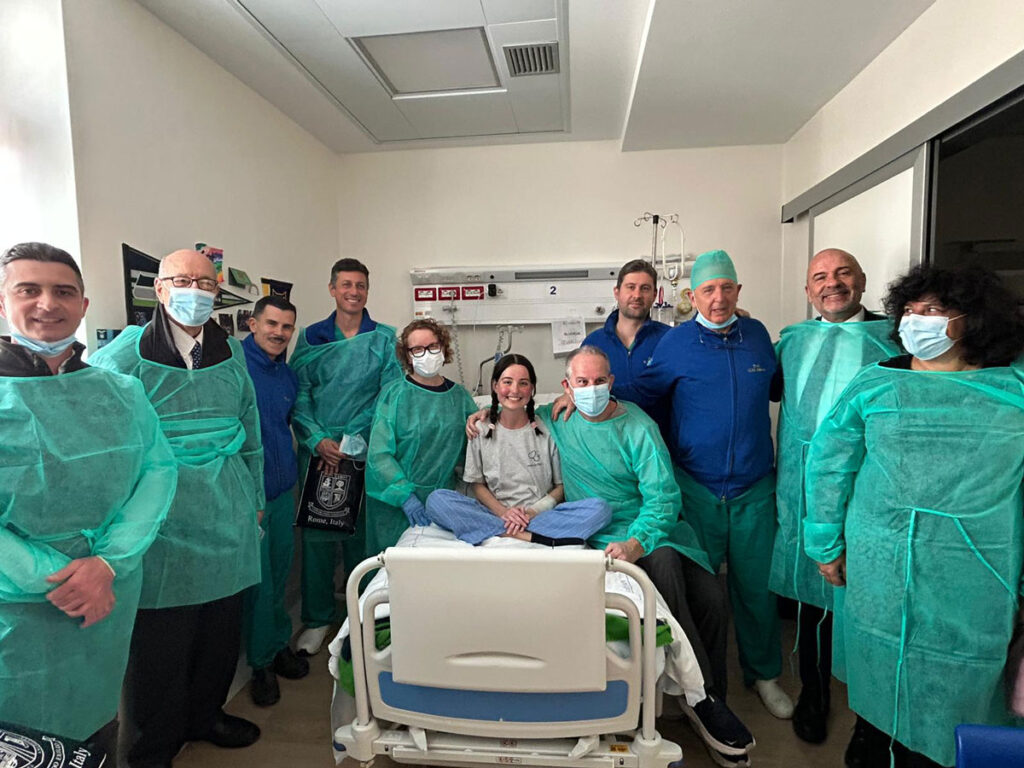
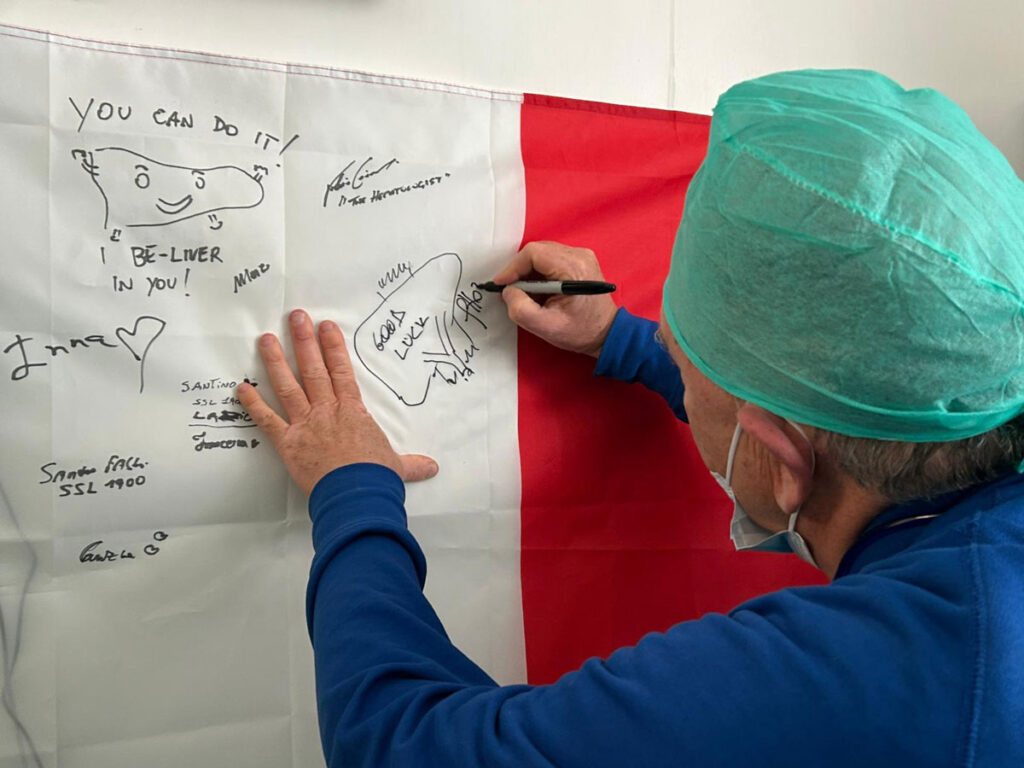
A-Life-Saving-Race-Against-Time-Lucy-Story-in-Rome

At that point, scared, Lucy contacted Dr Andrea Guerriero, medical advisor to John Cabot University and Chief Medical Officer at MedinAction, a 24/7, English-speaking, on-demand medical service for travelers, expats, and students in Italy. Dr Guerriero sensed the possible seriousness of the situation and advised her to return to Rome immediately. From that moment, a rapid support and referral process was set in motion to ensure she received urgent care as quickly as possible.

Once back in Rome, Lucy was first taken to UPMC Salvator Mundi International Hospital and then transferred to San Camillo-Forlanini Hospital. There, hepatologist Valerio Giannelli led the tests and examinations that resulted in the diagnosis of Wilson’s disease, a rare genetic disorder that in Lucy’s case had caused acute liver failure.

Acute liver failure (ALF) is a rare and serious condition where the liver stops working properly in a short amount of time, often in just a few days, even if the person had no previous liver problems. It can be life-threatening if not treated quickly. Therefore the only way to save her life was an urgent liver transplant.

Fortunately, thanks to the dedication of the medical professionals in the Italian health system, in a matter of days, a donor organ became available, and Lucy underwent transplant surgery performed by Professor Giuseppe Maria Ettorre, Director of General Surgery and Organ Transplantation, together with his team at San Camillo-Forlanini.

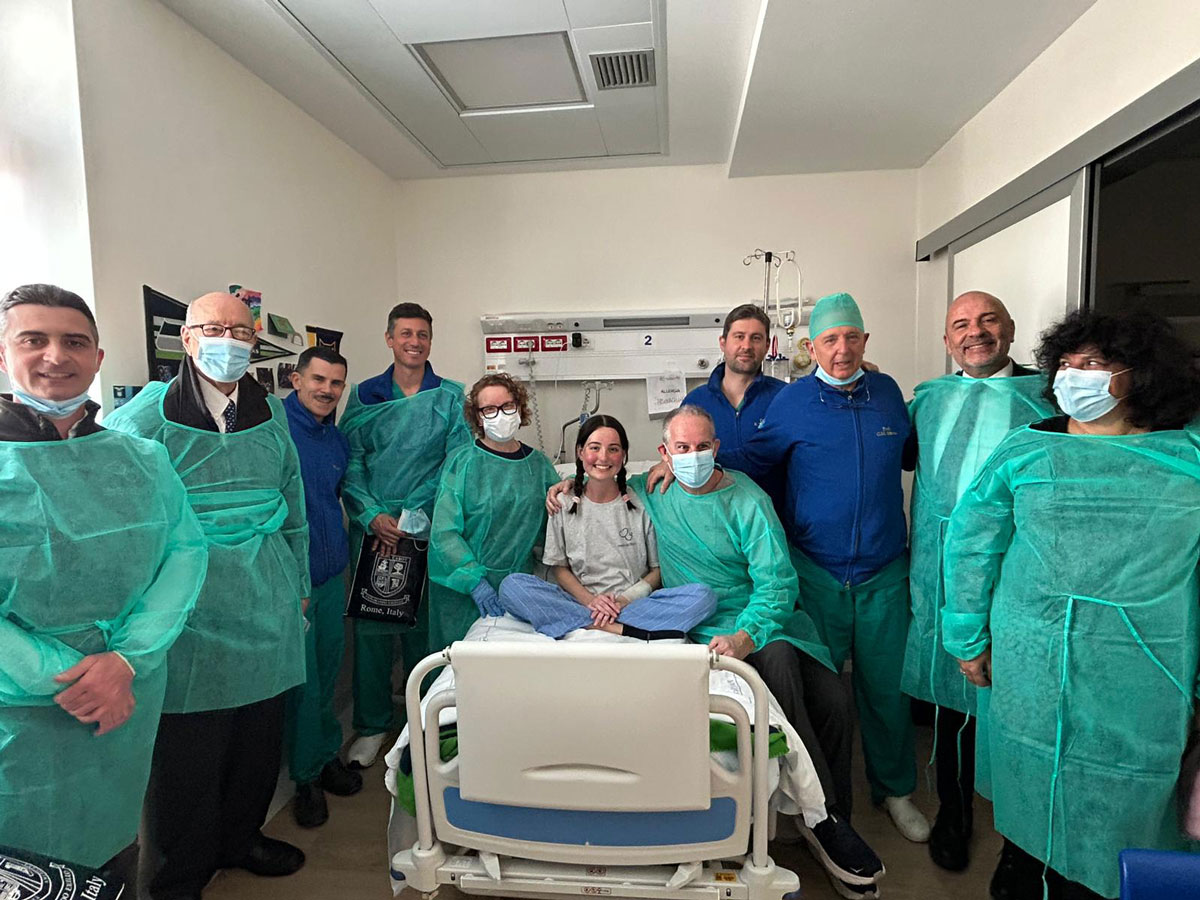
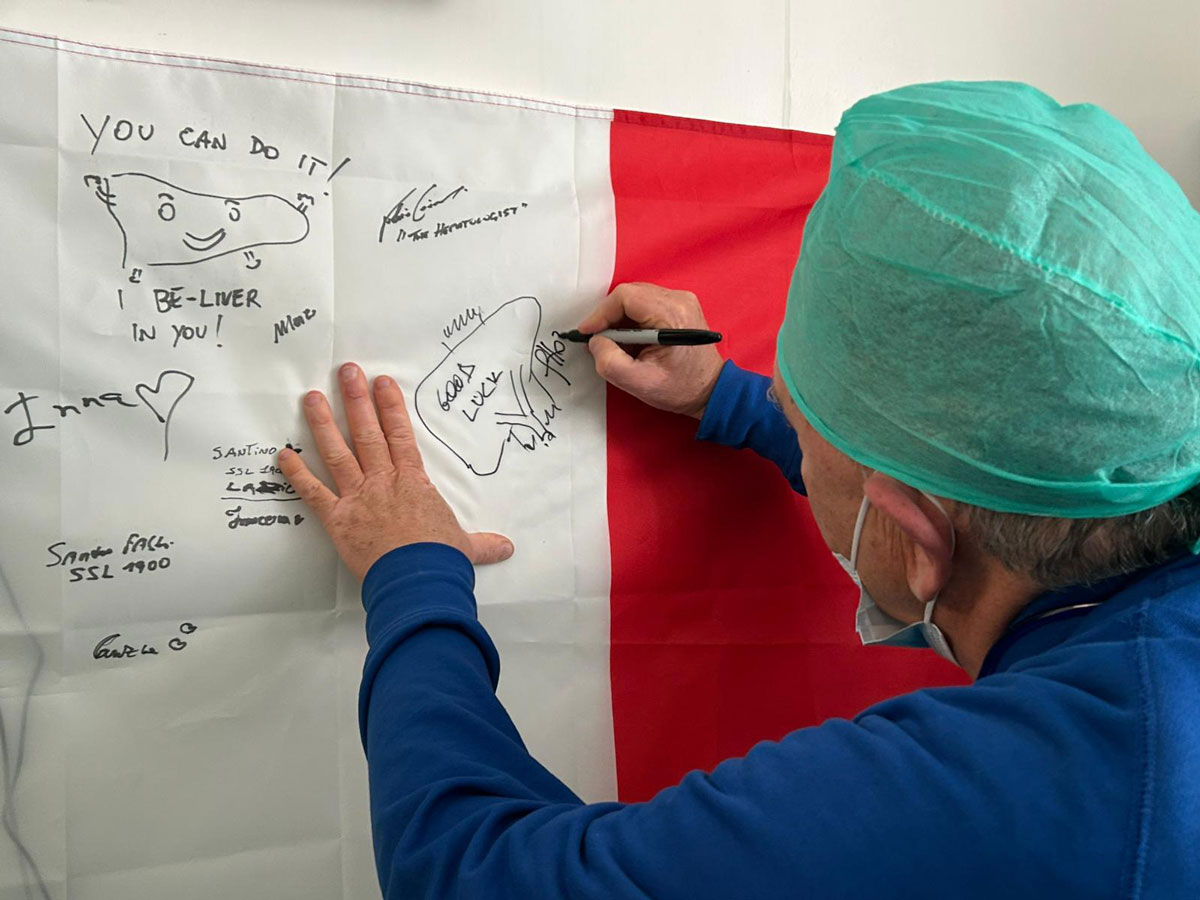
In-Rome,-a-21-Year-Old-American-Student-Receives-a-Second-Chance-at-Life

The operation was successful. Weeks later, Lucy is now in the company of her parents and is reportedly recovering without complications from the intervention.

For Rome’s international community, this story is a powerful reminder of how essential it is to have timely medical guidance, clear communication, and reliable support when facing a health emergency abroad.

In unexpected critical moments, information, speed, and human care can make all the difference.

The post American Student’s Life Saved in Rome After Urgent Liver Transplant appeared first on Romeing.
Caravaggio and the Masters of Light: Illuminating a Legacy

Caravaggio illuminates Rome once again! From March 7 to June 7, 2026, the Museo Storico della Fanteria invites visitors to immerse themselves in the art world of Caravaggism and the work of an entire generation of masters of light

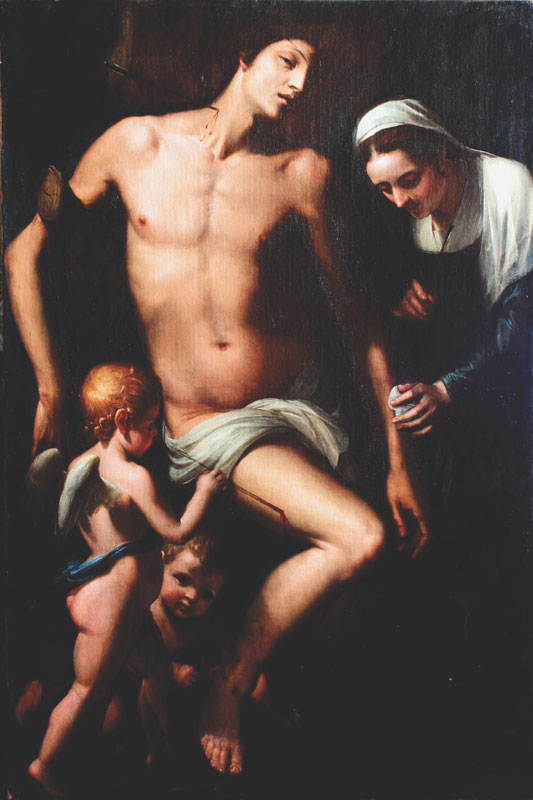
Curated by Alberto Bertuzzi and Francesco Mazzeo, this exhibition explores the influence of Michelangelo Merisi da Caravaggio on an entire generation of artists. Taking visitors on a unique journey that showcases the work of twenty-three prolific artists, including Bartolomeo Manfredi, Antiveduto Gramatica, Orazio Gentileschi, Massimo Stanzione, Giuseppe Vermiglio, Carlo Saraceni, Simon Vouet, among others. 

INSPIRATION
Where to See Caravaggio’s masterpieces in Rome

Caravaggio-and-the-Masters-of-Light-Museo-Storico-rome
Carlo Saraceni
San Sebastiano
Collezione privata

Light At Its Heart

Caravaggio’s exceptional mastery of light turned him into a transformative figure in the art world. Furthermore, it became a defining characteristic of his style, driving how others would approach and perceive oil painting.  

The exhibition, divided into six thematic sections, has light at its heart, portraying how it wasn’t just a means of illumination, but a powerful tool that immerses the viewer into the abstract side of emotion, narrative, and spiritual depth of the canvas.

Starting the journey with a piece by Bartolomeo Manfredi that conveys tension and drama, visitors engage with the experience of those who took the master’s challenge of showing how light can be a tool for emotion and storytelling. 

Caravaggio-and-the-Masters-of-Light
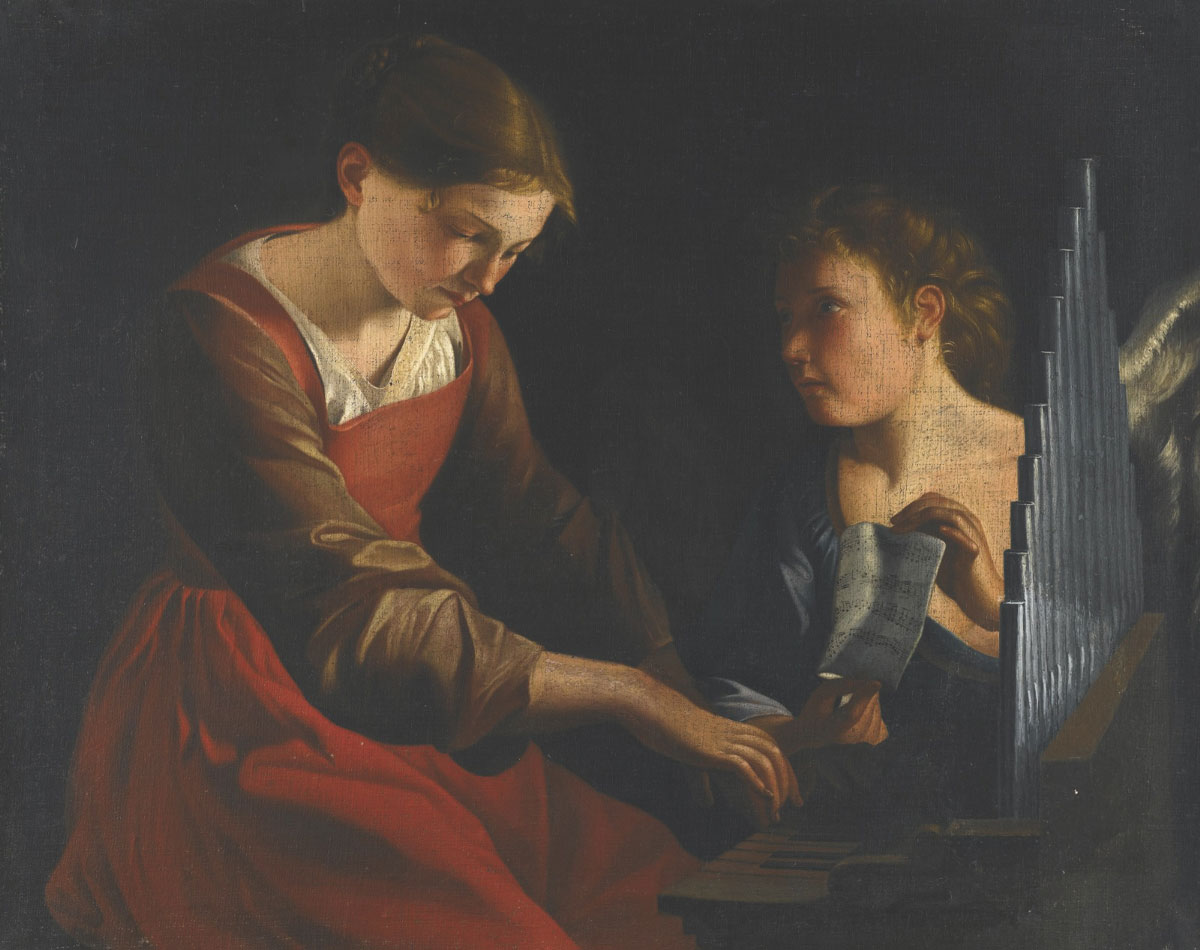
Orazio Gentileschi
Santa Cecilia e un angelo – XVII sec.
Collezione privata

Naturalism Meets the Power of Light 

As the exhibition unfolds, it leads you through the delicate balance of light and shadow in the works of artists like Orazio Gentileschi and Massimo Stanzione. Their masterpieces are a paradox of natural atmospheres and deep emotional scenes, using light as a companion to character emotion. 

Naturalism in art refers to the approach that seeks to resemble subjects as they appear in nature. Accuracy and detail are emphasized in this style, making light, texture, and form key components. 

The works in this section reveal delicate gestures and soft atmospheres. Light accompanies the emotions of the characters and gives depth to the scenes. This showcases the ability of Caravaggio’s followers to use his techniques while adapting them to different styles and perceptions. 

7.-CARAVAGGIO---Incredulita-San-Tommaso
Michelangelo Merisi detto Caravaggio
L’Incredulità di San Tommaso 1600-1601
Collezione privata

The Incredulity of Saint Thomas

The exhibition closes the journey with a masterpiece by Caravaggio and Prospero Orsi, The Incredulity of Saint Thomas

As a focal point of the exhibition, it exemplifies Caravaggio’s mastery in shaping forms and volumes with light. In it, viewers witness his skillful chiaroscuro and use of dramatic contrast, which allows for a unique ability to infuse human emotions into his subjects. The intensity captured in this work highlights and encapsulates Caravaggio’s legacy as a master figure in the history of art. 

Caravaggio’s Influence Beyond Italy

caravaggio-e-i-maestri-della-luce-mostra-roma
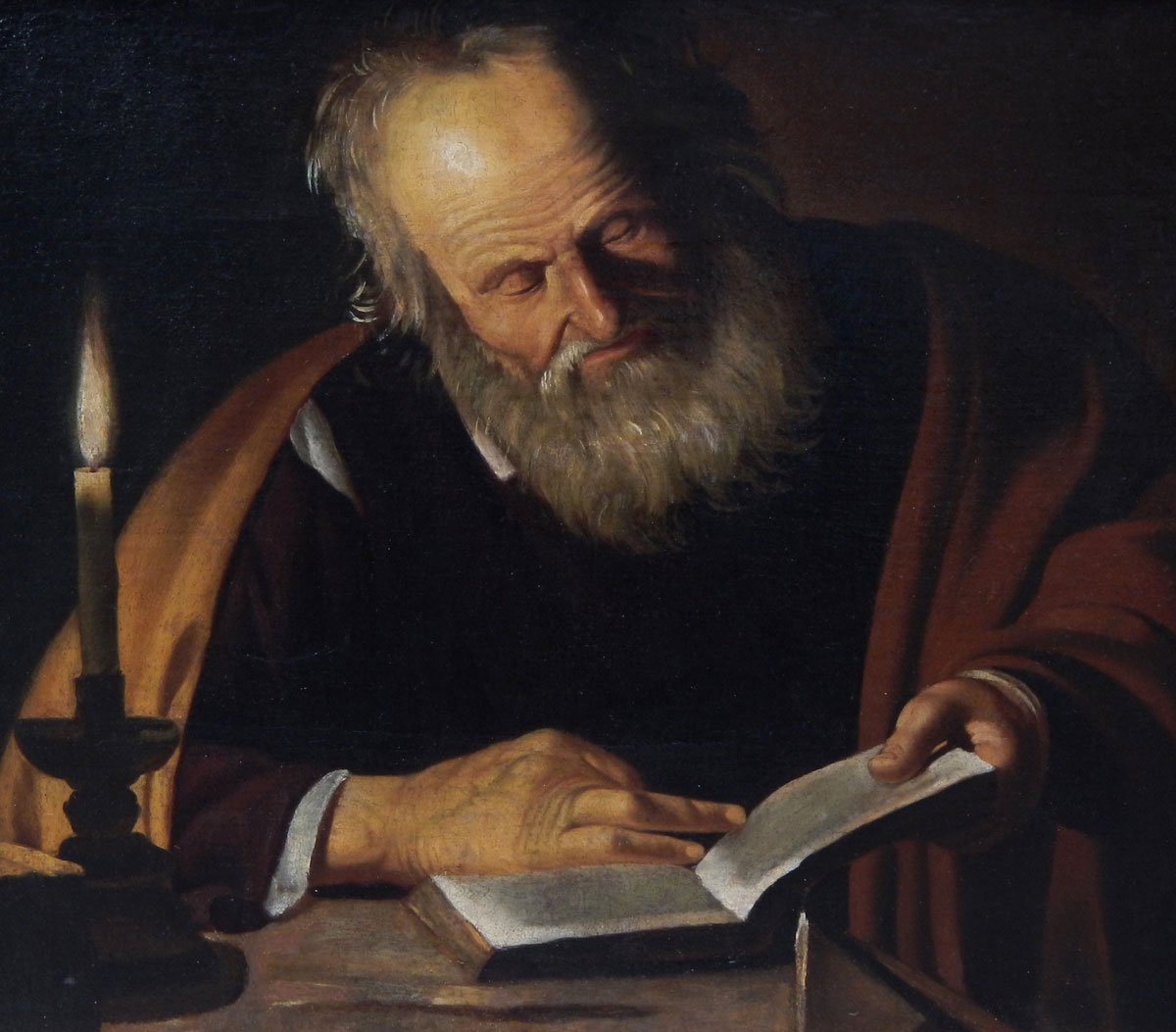
Gerrit van Honthorst
Lettura a lume di candela XVII sec.
Collezione privata

Caravaggio’s influence extended beyond Italian artists. 

Paintings by international artists like Matthias Stomer, Bartholomeus Van der Helstand, Jusepe de Ribera reveal how Caravaggio swayed the imaginations of artists across Europe. The exhibition takes you beyond Rome and Naples, exploring how Caravaggio’s ideas crossed borders into Spain, France, and the Netherlands. 

Furthermore it includes contributions from the Bolognese school, including works by Simone Cantarini, whose mastery of light and shadow harmonizes with Caravaggio’s original vision.

Their reinterpretations of Caravaggio’s light and shadow illustrate the far-reaching effects of this creative mastermind.

Don’t miss Matisse Exhibition at the same venue

While visiting the museum, you can also explore another major exhibition:
The Last Matisse – Morphologies of Paper,” on view at the same venue until June 28, 2026, dedicated to the master’s late works on paper and his innovative cut-outs.

The post Caravaggio and the Masters of Light: Illuminating a Legacy appeared first on Romeing.
Orazio Gentileschi Santa Cecilia e un angelo XVII sec. Olio su tela 83,4 x 105,2 cm Collezione privata

Michelangelo Merisi detto Caravaggio L’Incredulità di San Tommaso 1600-1601 Olio su tela 118 x 156,5 cm Collezione privata

Gerrit van Honthorst Lettura a lume di candela XVII sec. Oliosutela 64 x73cm Collezione privata
❌